SynMax Research:
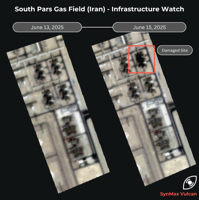
On February 28, 2026, the United States and Israel launched coordinated military strikes against Iranian strategic assets. Reuters has confirmed multiple explosions near Kharg Island, the terminal responsible for approximately 90–95% of Iran's crude oil exports. Any damages to the terminal’s export infrastructure have not been disclosed.
Vulcan Infrastructure Watch (IW) reviewed satellite imagery of Kharg Island immediately following the strikes. Initial imagery from February 28 was fully obscured by cloud cover. Partial visibility was achieved on March 1, and the results of that assessment are presented below.
Kharg Island: Strategic Significance
Located approximately 25 km off Iran’s Bushehr coast, Kharg Island is the most critical node in Iran’s energy architecture. As one of the world's highest-capacity terminals, its facilities have historically handled volumes exceeding 2 million barrels per day (mb/d).
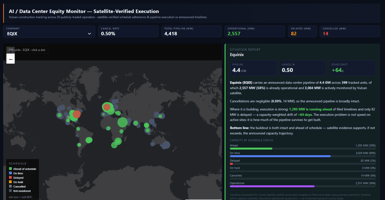
Using our agent we asked for a publicly available information dashboard on Kharg Island and its infrastructure.
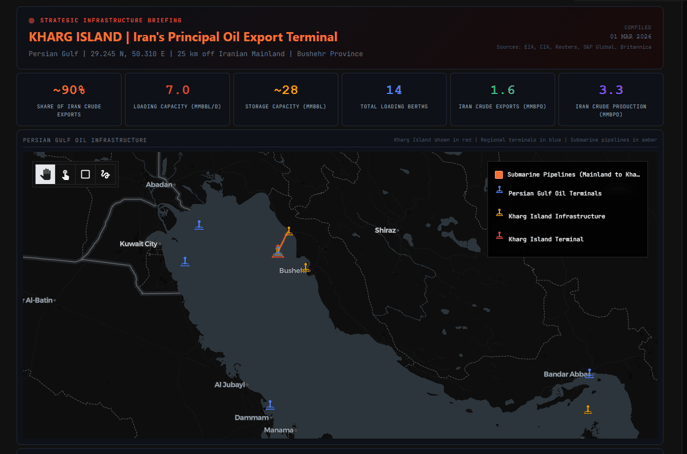
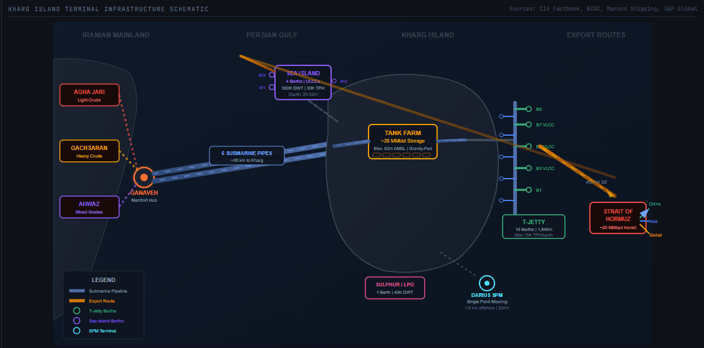
You can view the complete dashboard - and clients with API key can import the dashboard:
|
Metric |
Details |
|
Export Share |
90–95% of Iranian crude; 5x the volume of all other domestic terminals combined. Simultaneous loading of 8-9 Supertanker. |
|
Current Volume |
~1.6 mb/d average. Iran loadings to ~3 mb/d of recent confirmed by SynMax Dark Oil. |
|
Primary Offtaker |
China. Significant disruption forces Chinese refiners to seek substitutes on the spot market. |
|
Lack of Redundancy |
The Jask terminal remains functionally incomplete. Effective pipeline capacity is only 300,000 b/d, compared to Kharg’s 1.6 mb/d. |
Economic & Geopolitical Implications
- Domestic Impact: Disruption to Kharg directly impairs Tehran’s ability to fund government operations and regional military activities.
- Global Energy Security: This strike risks Iranian retaliation within the Strait of Hormuz, a chokepoint that averaged 20 million barrels per day in 2024 (roughly 20% of global petroleum liquids consumption).
- Alternative Routes: Most volumes transiting the Strait have no viable overland alternative. A prolonged closure would trigger a global energy crisis and jeopardize Middle Eastern food security, as the region accounts for 4.2% of global seaborne agricultural trade.
Satellite Imagery & Assessment
Vulcan Infrastructure Watch (IW) reviewed imagery following the strikes. While February 28 imagery was fully obscured by cloud cover, partial visibility was achieved on March 1.
- Baseline (Feb 27): Southern terminal area showed clear conditions and normal operations.
- Post-Strike (March 1): Despite partial cloud cover limiting the assessment to the central and southern sectors, comparison with the baseline reveals no significant structural changes to visible terminal infrastructure.
- Key Findings: Storage tank roof structures appear intact; the eastern pier and southern loading berths show no visible signs of damage.
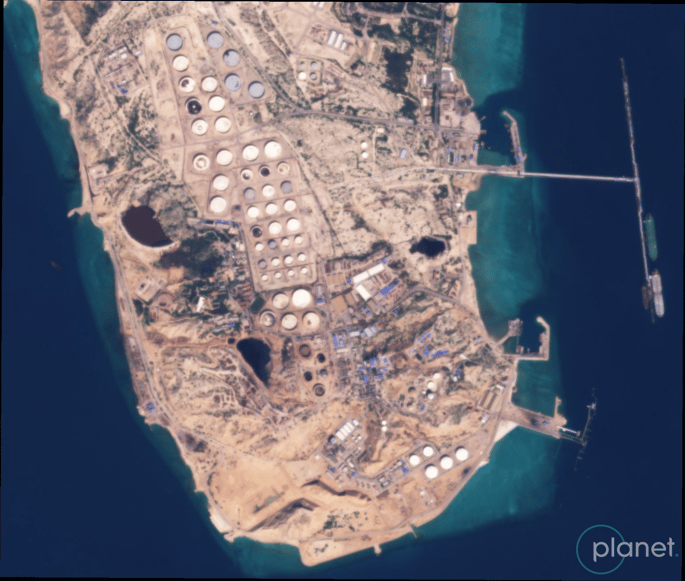
Kharg Island — February 27, 2026. Southern terminal area, clear condition. Imagery: Planet Labs PBC.
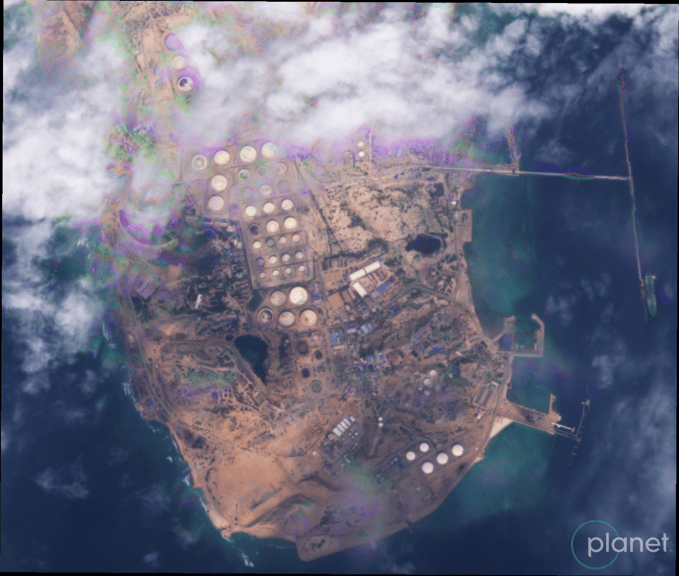
Kharg Island — March 1, 2026. Southern terminal area, partial cloud cover.Imagery: Planet Labs PBC.
Market Context
Brent crude closed Friday Feb 28 at $72.48/bbl (+2.45%), a seven-month high.
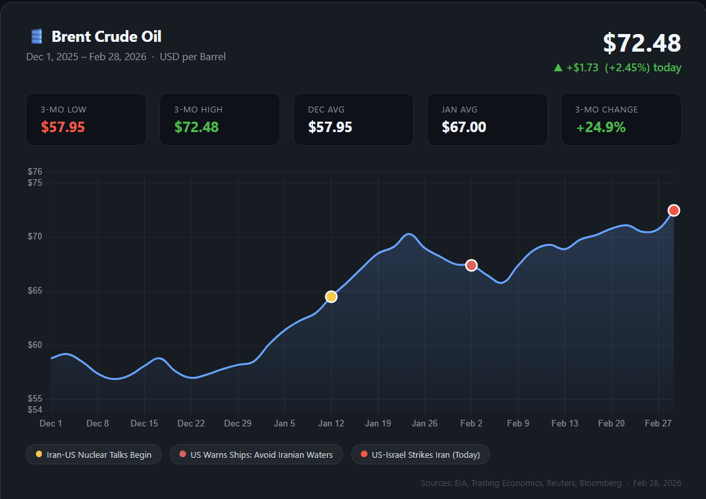
If the Strait of Hormuz is closed several pundits are noting over $100/bbl prices.
OPEC+ March 1 Meeting: Outcome
Decision: Resume production increases at an accelerated pace for April.
OPEC+ agreed to resume oil production increases at a slightly accelerated pace as a conflict sparked by US-Israeli strikes on Iran threatened to bolster a rally in crude prices. Key members led by Saudi Arabia and Russia will add 206,000 barrels per day in April, according to a statement after their monthly video conference on Sunday.
This is a bigger jump than the standard 137,000 b/d increment the group had been using - and the timing is clearly deliberate.
Vulcan Infrastructure Watch remains committed to monitoring significant events and providing insights to our customers regarding the status of affected energy infrastructure.