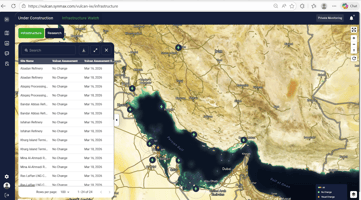
This update extends our ongoing Vulcan Infrastructure Watch (IW) assessment of critical energy and industrial infrastructure across the Persian Gulf. Since our last report (covering cycles through March 23), the conflict has continued to escalate; Iranian retaliatory strikes are now targeting heavy industry across multiple Gulf states. This update covers four additional site assessments completed between March 26 and March 30, 2026.
Assessment Methodology
All assessments utilize Sentinel-2 multispectral imagery at 10-meter resolution, benchmarked against pre-conflict baselines. Composite change scores and change overlay maps are generated via our automated pipeline. SWIR (Short-Wave Infrared) thermal detections are noted where present. Note: While 10-meter resolution provides a reliable screening layer, it may not capture localized or sub-pixel damage.
Summary of Findings
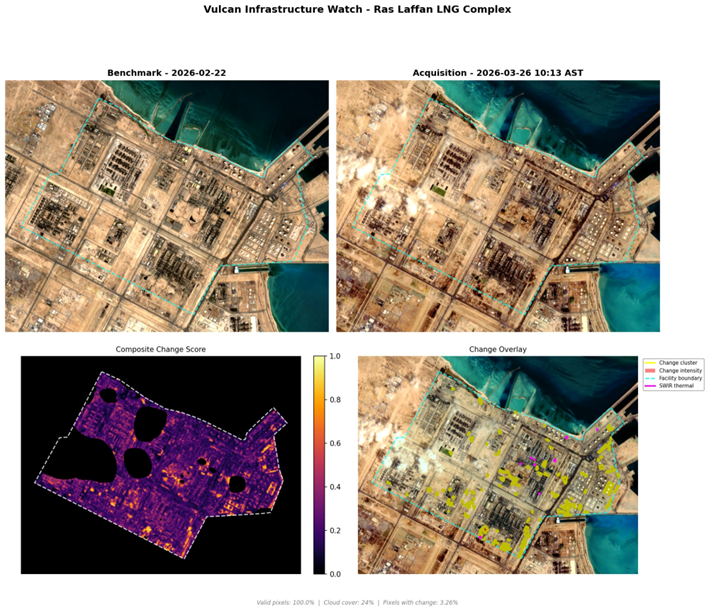
Of the 15 sites currently monitored by IW, this update covers four recent assessments: Ras Laffan LNG Complex, Bushehr Nuclear Power Plant, Alba Bahrain Smelter, and EGA Al Taweelah Smelter. Ras Laffan shows change clusters in our automated detection, though damages to individual components are not visible at 10-meter resolution. The remaining three sites were assessed following reported attacks and requests, and none show evidence of large-scale structural damage in our Sentinel-2 analysis.
Ras Laffan LNG Complex, Qatar
- Sector: LNG Production (~77 MTPA)
- Imagery Date: March 26, 2026
- Analysis: Our automated pipeline detected change clusters across multiple areas of the complex. However, at 10-meter resolution, damage to specific components remains unverified as all primary large-scale structures appear unchanged.
- Context: QatarEnergy halted production on March 2 following initial drone strikes. A subsequent, more severe wave of missile attacks on March 18–19 reportedly struck LNG Trains 4 and 6, disabling an estimated 12.8 MTPA of capacity (approx. 17% of Qatari exports). Force majeure has been declared on contracts to China, South Korea, Italy, and Belgium; repairs are projected to take three to five years.
Bushehr Nuclear Power Plant, Iran
- Sector: Nuclear (915 MW)
- Imagery Date: March 29, 2026
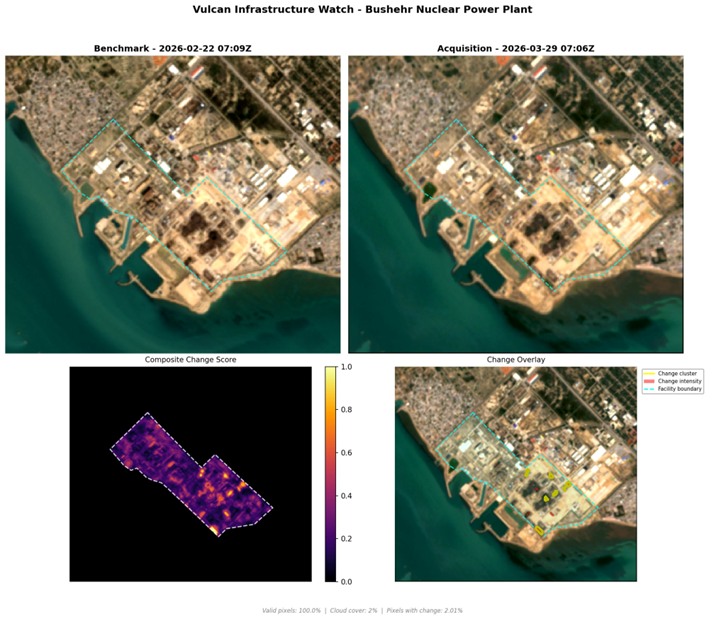
- Analysis: Imagery shows minimal change to the primary facility. Detected change clusters are concentrated along the southern waterfront rather than the reactor dome or critical plant structures. No evidence of large-scale structural damage is visible.
- Context: This site was prioritized following reports of at least three projectile strikes (March 17, 24, and 27–28). The IAEA has since confirmed no reported reactor damage or radiation leaks.
Alba Bahrain Smelter, Bahrain
- Sector: Aluminum (1.6 MTPA / ~2.5 GW load)
- Imagery Date: March 29, 2026
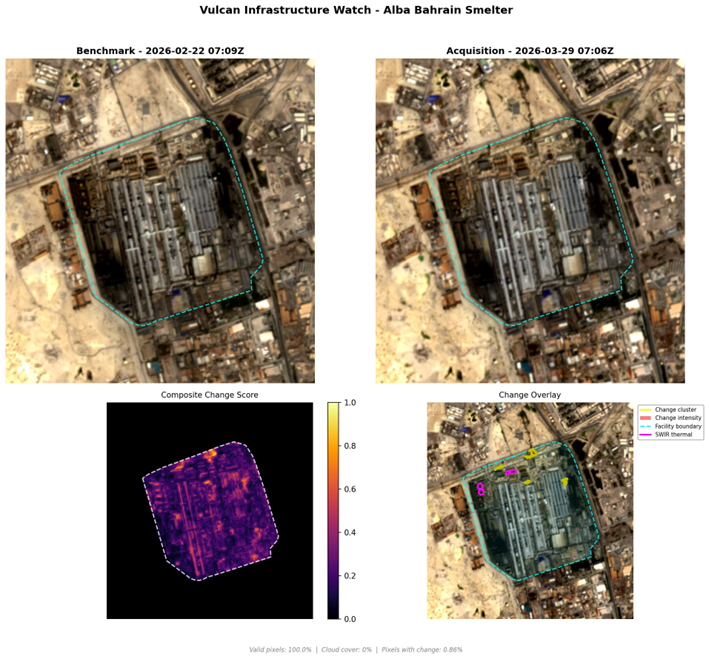
- Analysis: Very limited change detected. Minor clusters are visible along the northern perimeter. SWIR thermal signatures are present but appear consistent with standard smelter operations rather than fire damage.
- Context: Assessment followed reported Iranian attacks on March 28. Alba initiated a 19% production cut on March 15 due to the Strait of Hormuz closure. With Gulf producers representing 9% of global supply, aluminum prices have surged above $3,400/tonne.
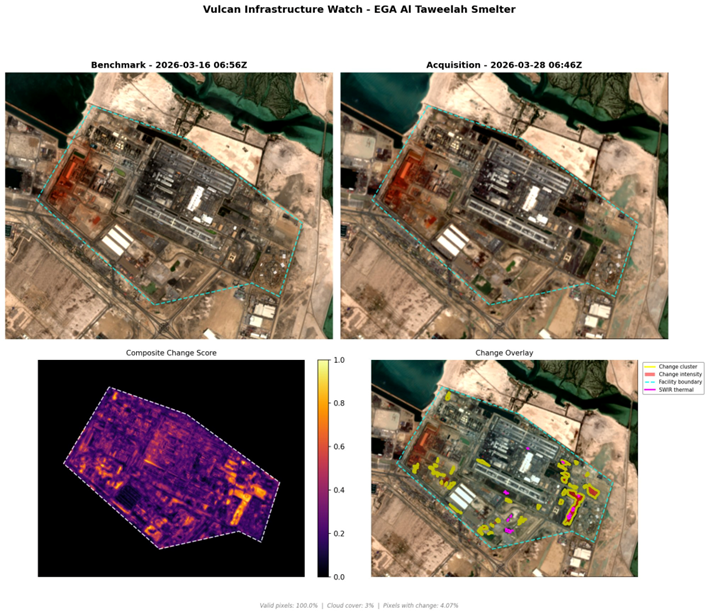
EGA Al Taweelah Smelter, UAE
- Sector: Aluminum (1.6 MTPA / ~2.5 GW load)
- Imagery Date: March 28, 2026
- Analysis: High levels of change were detected surrounding the site; however, these clusters and SWIR signatures are distributed across central and eastern zones, away from the primary smelter complex.
- Note: Aluminum smelters produce significant baseline thermal signatures; detected fluctuations may reflect operational variance rather than combat damage.
- Context: Requested following the March 28 attacks. While EGA described "significant damage" from missile and drone strikes, satellite verification of core infrastructure remains inconclusive. EGA is a critical supplier for Boeing and Airbus.