SynMax Research:
What This Report Tells You
After reading this report you will know: whether Vineland is actually online, how far reported dates have drifted from physical reality, and what that gap means for any PJM demand model or Nebius capacity position.
⚡ Bottom Line
Many list 100 MW at Vineland as operational. Our June 3 thermal drone found zero heat signature on either unit. DC01 is 7+ months past its reported in-service date. DC02 was reported online 78 days before construction makes it physically possible. Every model treating this capacity as live is wrong.
Site at a Glance
|
Entity |
Nebius Group NV |
|
Location |
Vineland, New Jersey (PJM) |
|
Planned Scope |
6 units × 50 MW = 300 MW total (IIR Energy Source) |
|
Current Flight |
June 3, 2026 |
|
Prior Flight |
March 9, 2026 |
Background
On March 9, 2026 we flew a thermal drone over the Vineland Data Center and found a campus that did not match the operational picture carried in industry data feeds. We returned on June 3, 2026, twelve weeks later, to determine whether the site had energized. It had not. DC01 remains structurally complete but thermally cold, DC02 is still under active construction, and the reported in-service dates continue to run ahead of physical readiness.
Many continue to carry both DC01 and DC02 as operational, with reported in-service dates of 10/31/2025 and 2/27/2026. Our June 3 thermal review is inconsistent with those classifications. DC01 now sits more than seven months past its reported start, and Vulcan’s median modeled online date of 4/29/2026 has also passed, with no heat signature on the roof. DC02’s reported in-service date precedes the earliest date our models consider feasible by 78 days. The original report on the site is available here: From Land Clearing to Thermal Signatures.
Entity: Nebius Group NV, Vineland, New Jersey (PJM)
Scope: 6 units planned (50 MW each), 300 MW total (IIR Energy)
Current flight: June 3, 2026
Prior flight: March 9, 2026
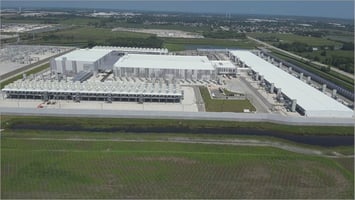
The campus below, imaged on June 3, shows the two units in the same phases identified in March, now further apart in maturity.
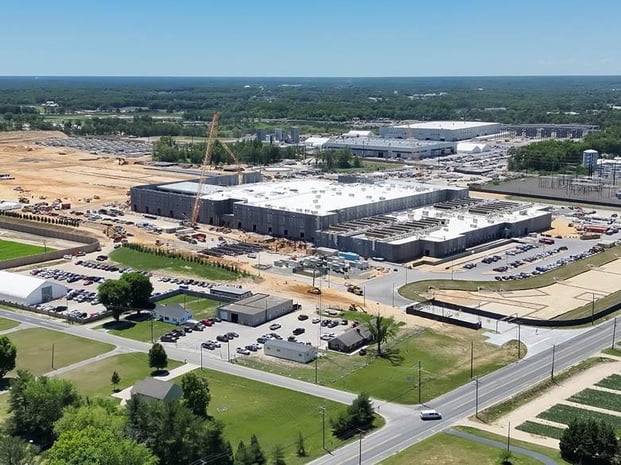
Campus overview, 6/3/2026. DC01, the completed building right of center, carries its rooftop cooling plant. DC02, to the left, remains under construction. The substation serving the site sits to the east.
Unit Status (as of 6/3/2026)
|
Unit |
Capacity |
Reported Status (IIR Energy) |
Reported Startup (IIR Energy) |
Vulcan Construction Status |
Thermal Review (2026-06-03) |
|
DC01 |
50 MW |
Operational |
2025-10-31 |
Confirmed |
Not Operational |
|
DC02 |
50 MW |
Operational |
2026-02-27 |
Identified |
Under Construction |
|
DC03 |
50 MW |
Under Construction |
2027-01-29 |
No construction |
-- |
|
DC04 |
50 MW |
Planned |
2027-10-29 |
No construction |
-- |
|
DC05 |
50 MW |
Planned |
2028-07-31 |
No construction |
-- |
|
DC06 |
50 MW |
Planned |
2029-08-31 |
No construction |
-- |
Confirmed and Identified are both active-construction classifications. Confirmed denotes construction verified on our first review; Identified denotes construction verified on a subsequent review. No construction indicates the unit is not under construction in Vulcan monitoring.
Unit DC01 (50 MW): Not Operational
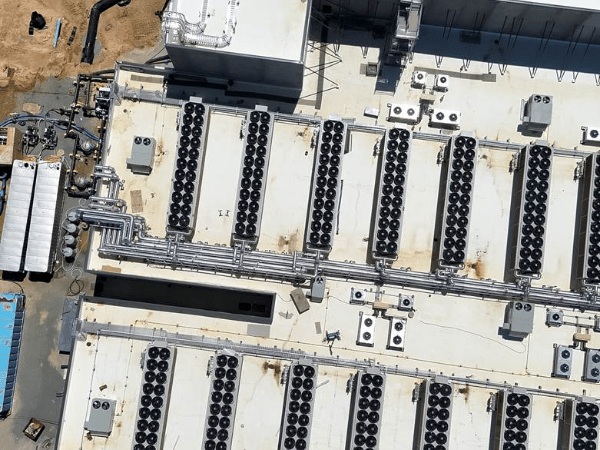
DC01 carries a reported in-service date of 10/31/2025. Vulcan classifies the unit as Confirmed, with land cleared on 2/22/2025 and construction start on 3/12/2025. The rooftop cooling equipment appears installed across the roof, including rows of dry coolers, packaged condensing units, stainless steel headers, and heat-exchanger skids set along the west edge.
The thermal imagery indicates the unit is not in operation. The cooling equipment presents a uniformly cold profile, and the warmer tones track solar loading on the roof and bare metal surfaces rather than process heat. A data center operating at this scale would reject substantial, clearly differentiated heat through its cooling plant, and no such signature is present. More than seven months after the reported in-service date, DC01 is structurally complete but shows no sign of operation.
🔍 Why It Matters
A data center operating at 50 MW rejects roughly 50–170 MW of heat through its cooling plant depending on PUE. That signature is impossible to miss in thermal imagery. The absence of any signature is a definitive finding, not a marginal one.
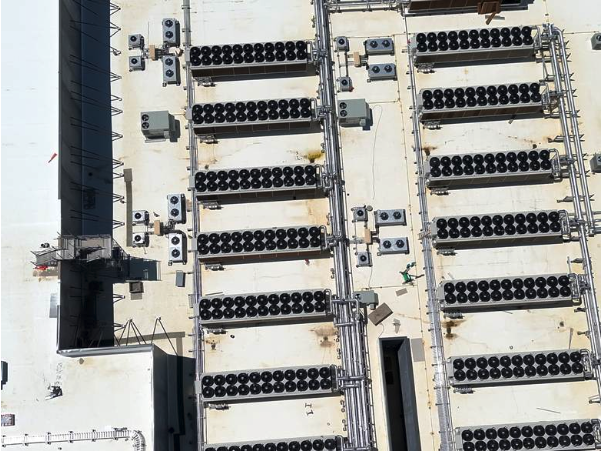
DC01 rooftop, 6/3/2026. Dry coolers, condensing units, and steel headers are in place across the roof.
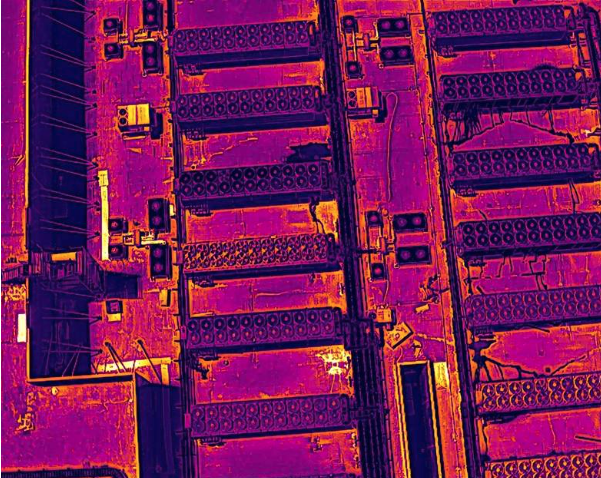
The same view in thermal. The cooler banks read uniformly cold; the warmer tones are solar loading on the roof and piping, not heat rejection.
A second section of the DC01 roof, 6/3/2026.
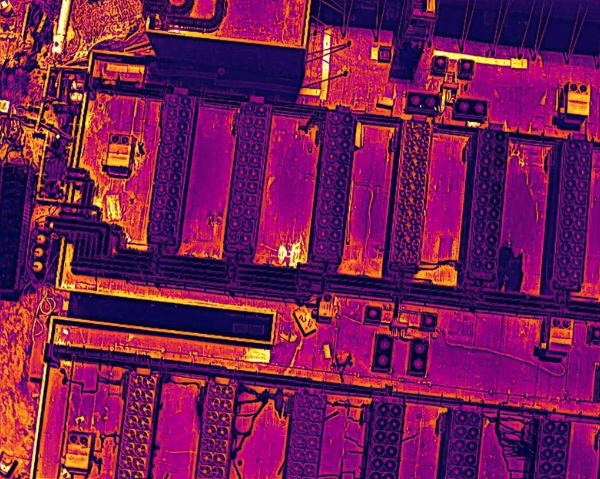
The same section in thermal. The cooling equipment reads cold across the array, with no concentrated heat rejection.
Unit DC02 (50 MW): Under Construction
DC02 carries a reported in-service date of 2/27/2026. Vulcan classifies it as Identified, with land cleared on 10/17/2025 and construction started on 1/22/2026. In March the unit erected steel columns and early wall-panel work. As of 6/3/2026 the precast envelope is largely up and roof decking is being placed, though multiple bays remain open to the floor below and no cooling equipment is installed. The unit is months from completion and could not have been operational on its reported in-service date, which precedes the earliest date our models consider feasible by 78 days.
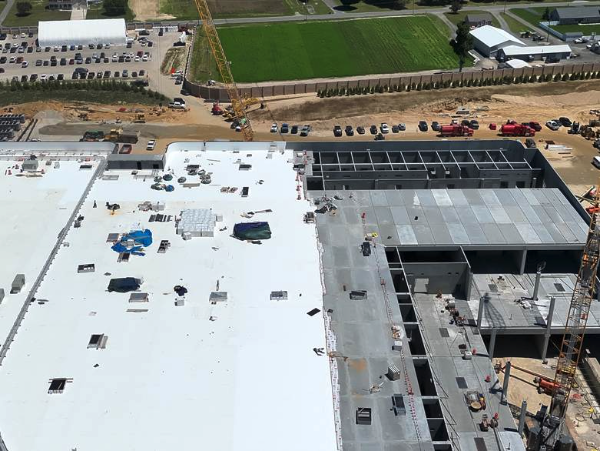
DC01, at left, meets DC02 under construction at right, 6/3/2026. DC02 walls are erected with roof decking in progress over open bays.
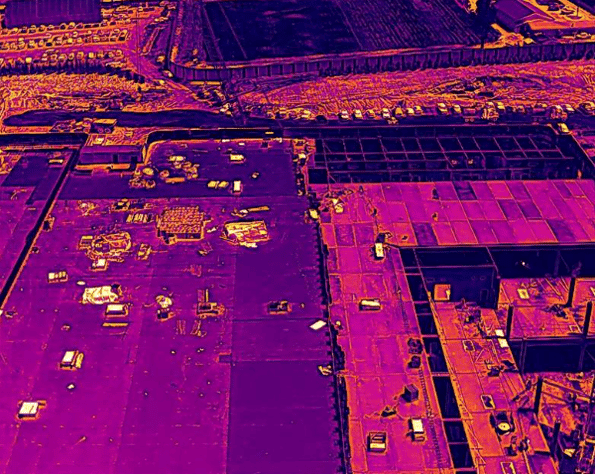
The same boundary in thermal. The DC01 roof reads cool; the warmer tone over DC02 is solar-heated bare concrete, not an operational signature.
Reported Timelines vs Observed Construction
For the two units under active construction, the gap between the reported online dates and Vulcan’s modeled feasibility windows quantifies the optimism in the public record.
|
Unit |
Reported Online (IIR Energy) |
Vulcan Earliest |
Vulcan Median |
Vulcan Latest |
Reported vs Vulcan Earliest |
|
DC01 |
2025-10-31 |
2025-07-04 |
2026-04-29 |
2027-06-11 |
119 days after earliest feasible |
|
DC02 |
2026-02-27 |
2026-05-16 |
2027-03-11 |
2028-04-22 |
78 days before earliest feasible |
Vulcan models an earliest, median, and latest feasible online date from observed construction milestones. DC02’s reported in-service date falls before its earliest feasible date, a physically impossible startup.
The distinction matters for any desk modeling PJM demand growth or Nebius capacity additions. Many currently show 100 MW at Vineland as in service, yet neither unit shows an operational signature on June 3. The interval between an announced in-service date and a verified energized facility is where forecasting error accumulates, and closing that interval with direct observation is what the Vulcan drone program is built to do.
Direct Intelligence at Your Fingertips
Vulcan pairs satellite monitoring with on-site thermal drone verification, providing the ground truth needed to look past reported milestones.
• For current clients: You direct our intelligence gathering. Vulcan runs 1 to 2 dedicated thermal drone flights per week based on subscriber demand. Submit site suggestions or commission targeted flyovers to validate your highest-conviction positions.
• Custom mission requests: Send drone flight suggestions to David Bellman at dbellman@synmax.com.
About SynMax Vulcan
Vulcan monitors U.S. power generation, datacenter, and LNG projects using satellite imagery to independently verify construction status and predict online dates — separate from official EIA estimates. Coverage includes project-level ranking (0–7), weekly progress indicators, and completion detection.
For API access, data licensing, or questions about this analysis, contact the SynMax research team.