Week Ending July 24, 2026 SynMax Analytics | Published July 29, 2026 Headline SynMax models a +33...
Headline: modeled injection tightens sharply to +55 Bcf
SynMax's modeled storage build for the week ending July 3 came in at +55 Bcf, a 32 Bcf tighter print than the +87 Bcf posted for week ending June 26. The implied end-of-week working-gas level rises to ~2,977 Bcf .
What moved the balance
Production — flat (+0.21 Bcf/d). Supply was a non-event: dry gas held right at ~110 Bcf/d across both weeks. Production offered essentially no offset to the demand surge.
LNG feedgas — flat (−0.08 Bcf/d). Total feedgas held at ~19.1 Bcf/d. No terminal-level disruption or ramp; LNG was not a factor in the week's tightening.
Electric power burn — the dominant driver (+4.74 Bcf/d). Power demand jumped from 40.5 to 45.2 Bcf/d and single-handedly accounts for the entire increase in net demand. This is the story of the week — but the weather-adjusted read below is the important nuance.
Population-weighted degree days — sharply hotter. Pop-weighted total degree days rose +4.58 per day (8.57 → 13.15).
The nuance: weather-adjusted power burn actually softened. Raw power burn rose +4.74 Bcf/d — but the heat implied it should have risen more. Regressing summer electric-power demand on CDD (slope ≈ 1.56 Bcf/d per CDD, n=67):
Interpretation: the +4.59 CDD jump "should have" added ~7.2 Bcf/d of power burn; actual burn added only ~4.7 Bcf/d. On a weather-normalized basis, power demand ran ~1.4 Bcf/d below expectation this week vs. ~1.0 Bcf/d above last week — a 2.4 Bcf/d softening. Gas-for-power is underperforming the heat, consistent with strong renewable/nuclear displacement and efficient combined-cycle dispatch. The screaming headline number (+4.7 power) is real, but it's weaker than the weather alone would justify.
Other S&D shifts (all secondary)
Pipeline & Distribution Use: +0.31 Bcf/d — the only other demand component with a meaningful uptick, but purely driven by the other demand increases..
Res/Com: −0.41 Bcf/d combined (Commercial −0.27, Residential −0.15) — mild seasonal fade, partially offsetting power.
Balancing Factor: −0.18 Bcf/d (more negative — a modest model tightening adjustment).
Industrial: −0.15 Bcf/d — effectively flat.
Mexican exports: −0.11 / Canadian exports: +0.09 — trade flows roughly a wash.
None of these individually rivals the power/weather move; the week is fundamentally a cooling-demand tightening only partly validated by weather-adjusted burns.
Modeled vs. EIA storage — last 4 reported weeks
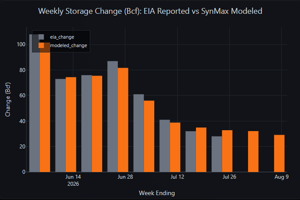
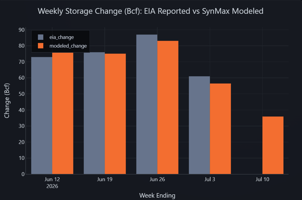
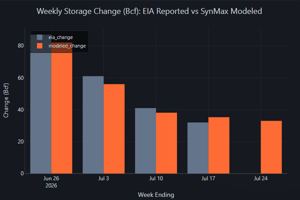
SynMax's modeled weekly change has tracked EIA closely, averaging within ~2 Bcf:
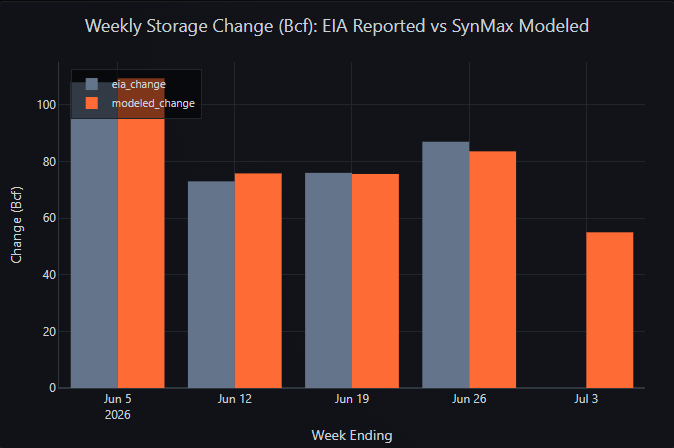
4-week mean absolute miss ≈ 2.0 Bcf — well inside EIA's own weekly reclassification/revision noise. The model ran slightly heavy on injections in early June and has trended modestly light the last two weeks (−0.4, −3.4), suggesting if anything a small conservative bias into the July 3 print.
Bottom line
The injection collapsed 32 Bcf week-over-week almost purely on a +4.7 Bcf/d surge in power burn driven by a +58% jump in cooling degree days, with production and LNG flat. The one caveat worth flagging to a trading desk: weather-adjusted power demand actually eased ~2.4 Bcf/d, so the raw tightening overstates underlying demand strength — the balance is hot-weather-tight, not structurally-tight.
See the full analysis on the dashboard
New Dataset Release: US Demand
SynMax has released a new US Gas Demand Dataset for our Hyperion Clients. It consists of a daily demand estimate, broken out by EIA gas storage region and by demand component.
It covers the four weather-driven end-use sectors (Residential, Commercial, Industrial, and Electric Power), built as an ensemble of pipeline flow data and weather-driven modeling, calibrated to EIA's monthly totals. It also includes LNG feedgas at all US liquefaction and regasification terminals, pipeline trade flows with Mexico and Canada, and supporting components like lease/plant fuel and pipeline/distribution use — giving a complete, regionally resolved daily picture of the lower-48 gas balance.
The data is currently out on query_datalinks and on Agents and will be rolled out to the SynMax frontend and the traditional API over the coming weeks. See here for overview and access methods, and here for full methodology and details.
As usual, contact support@synmax.com with questions.