Executive Summary
US natural gas demand is reported by EIA only monthly and on roughly a two-month lag, leaving a blind spot over exactly the period that matters most: right now. Our demand dataset replaces that wait with a daily estimate of consumption, broken out by EIA gas storage region and by component, refreshed as new data arrives. Do note that this is longer than our usual emails, and might be better read on the web. For details on accessing this data, see the original announcement.
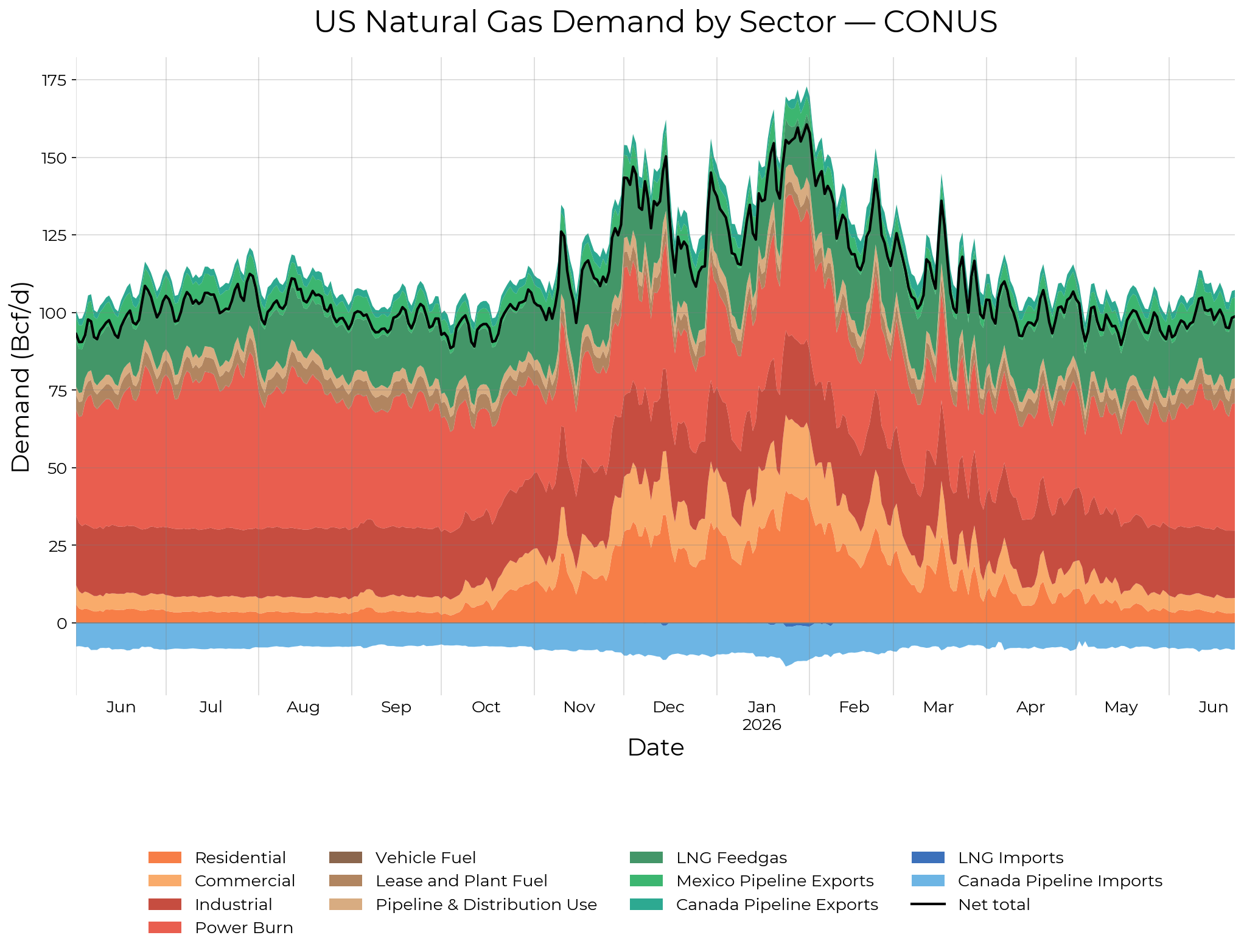
The four weather-driven end-use sectors, Residential, Commercial, Industrial, and Electric Power, are built as an ensemble: we blend two independent reads on demand, one from physical pipeline flows and one from a weather-driven model, add the structural drivers each sector responds to, and calibrate the result to EIA monthly consumption. The remaining components: LNG feedgas, LNG imports, pipeline trade with Mexico and Canada, and the supporting fuel uses, are each modeled to their own physical drivers. The result is a complete, regionally resolved daily demand series that stays current while remaining tied to ground truth.
This note goes one level deeper than the announcement post into how each component is modeled. We cover the four weather-driven sectors first, then the trade flows and supporting components that round out the lower-48 balance.
The Core Sectors: An Ensemble Nowcast
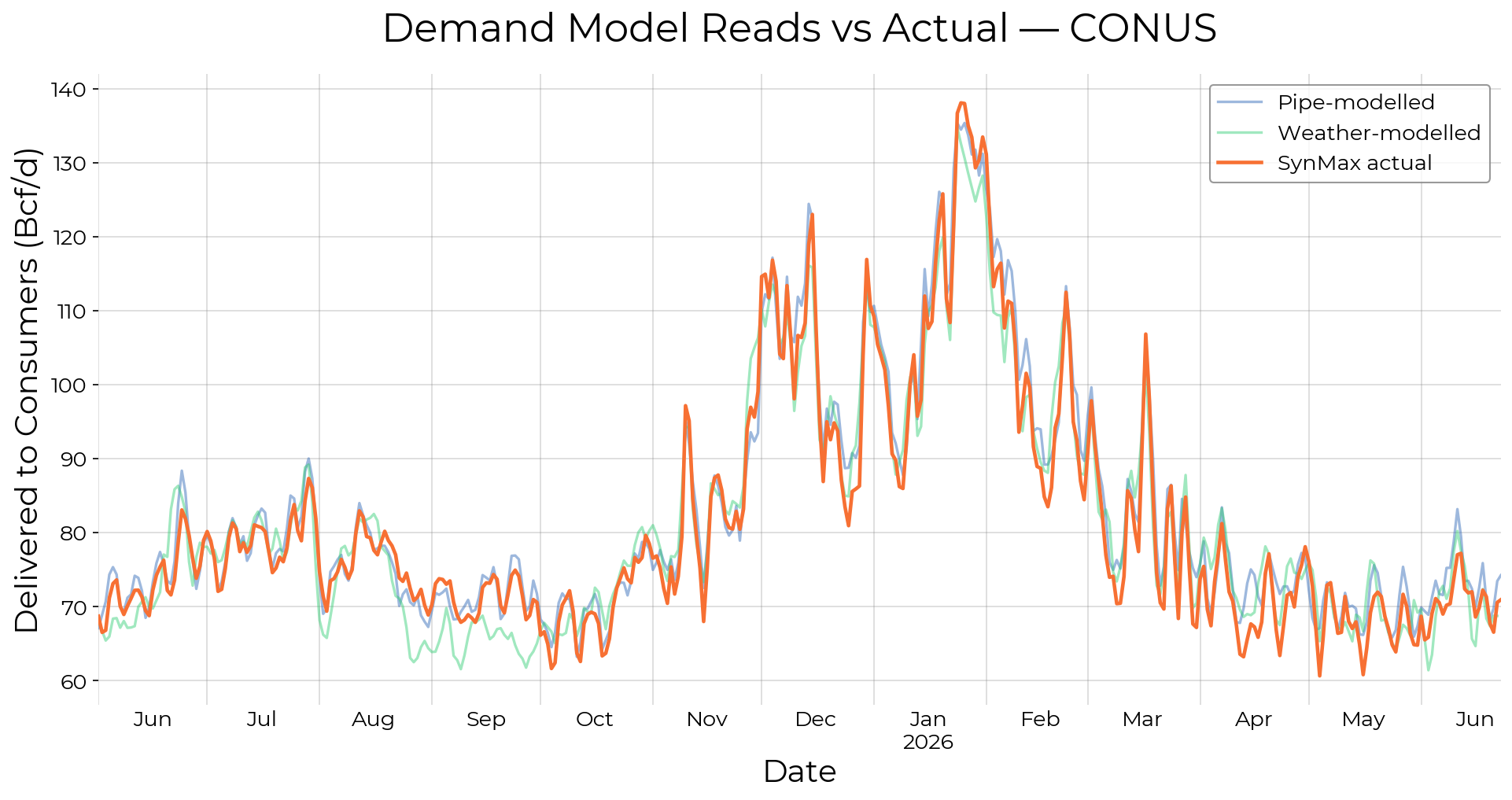
Using two independent signals is the heart of our approach. An error in either the pipeline or the weather data alone is balanced against the other, and the degree of agreement between the two provides a direct, built-in measure of confidence. The pipeline data is probabilistic, so when its own uncertainty flags it as unreliable the blend can discount it and lean on the weather signal. From there, each sector is modeled with the structural drivers and functional form that fit its behavior, rather than forcing one shape onto all four.
Residential and Commercial
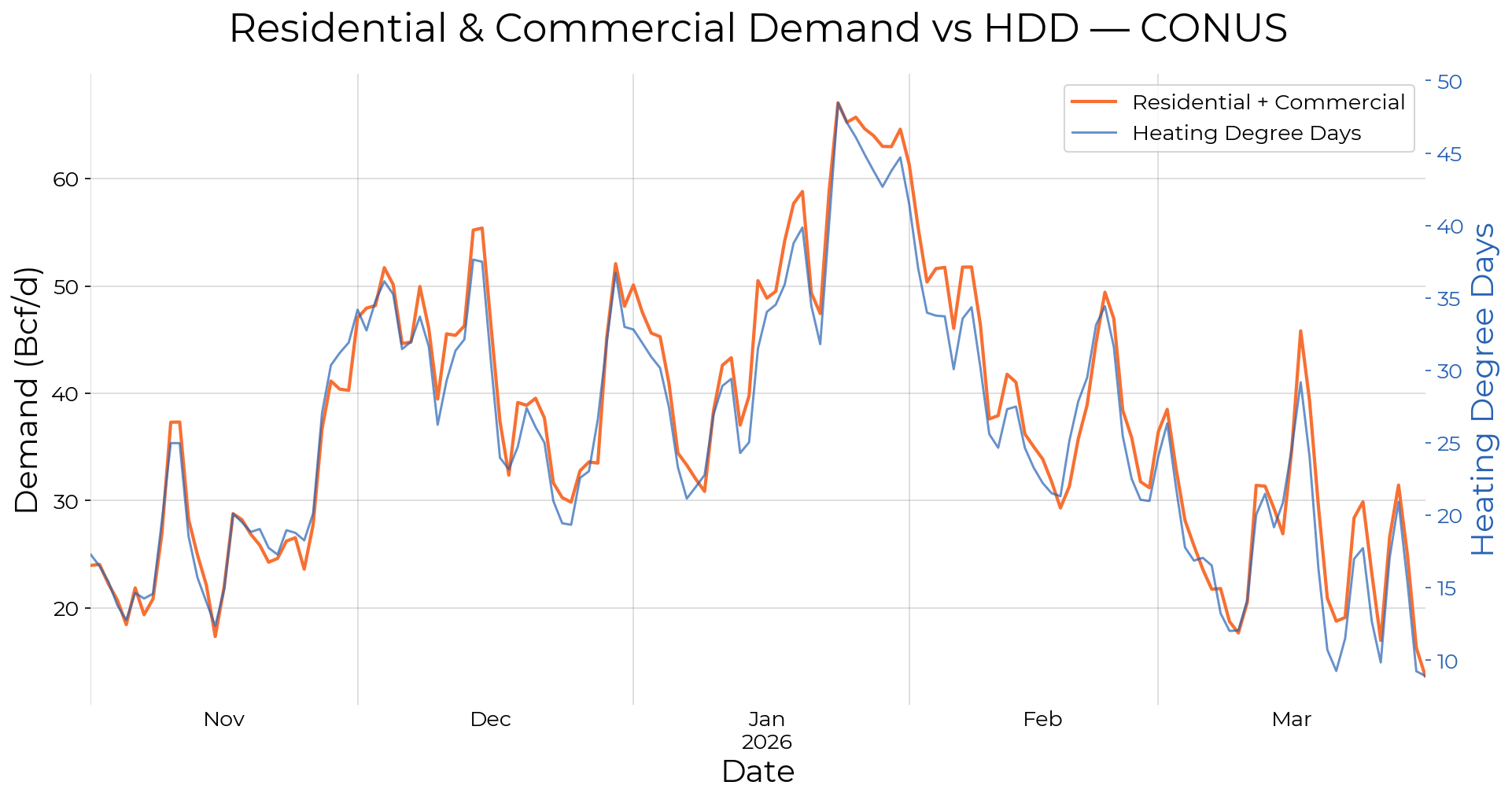
Residential and commercial demand is dominated by space heating, so it is the most temperature-sensitive part of the system. These sectors use population-weighted heating and cooling degree days as their weather input, alongside the pipeline signals. The model forms a weighted blend of the pipeline and weather estimates, then gates the two against heating conditions: the degree-day response carries more weight through the heart of the winter, and the blended signal carries more weight the rest of the year. The result tracks cold snaps closely in season while staying stable in the shoulder months.
Power Burn
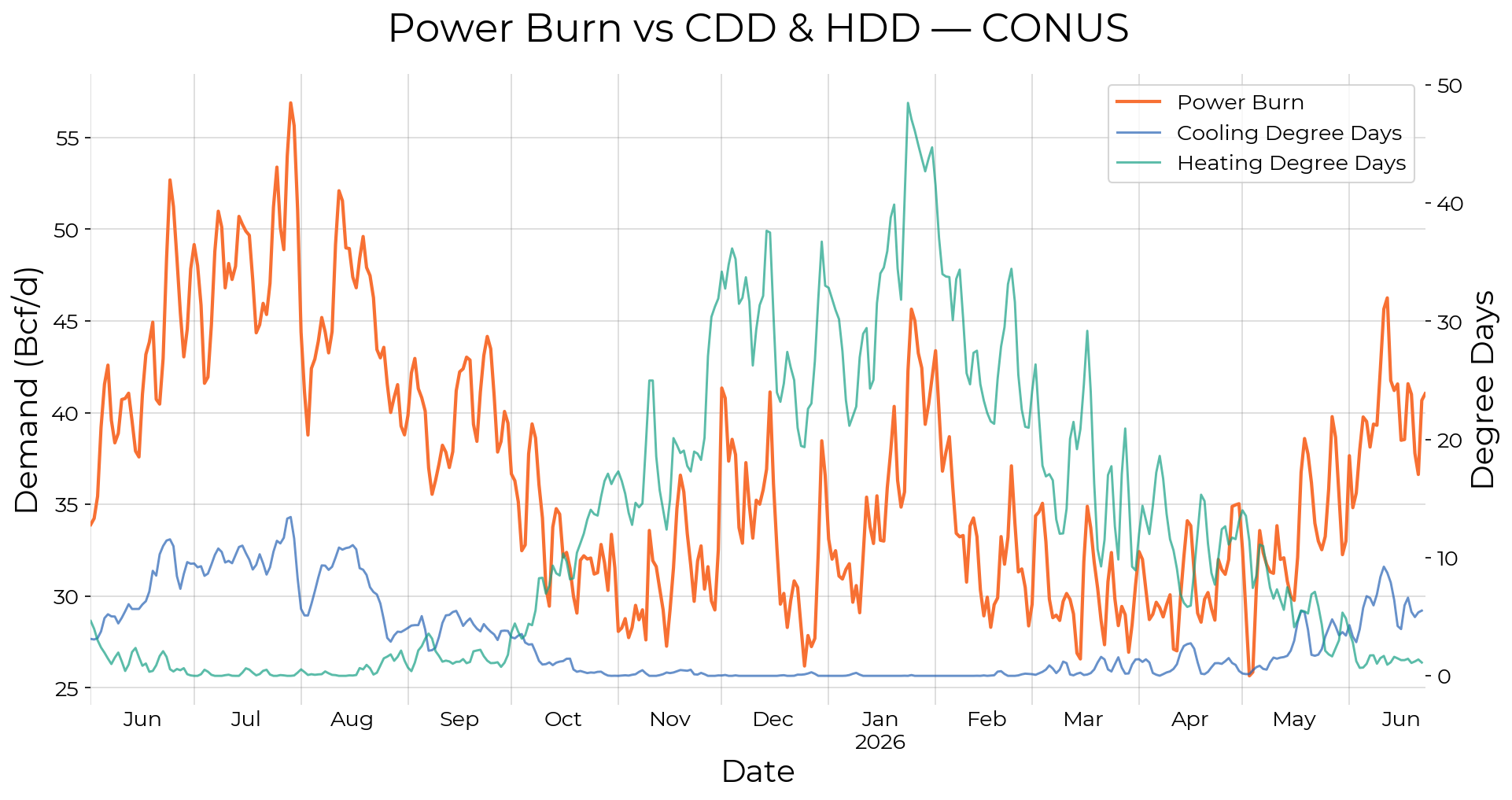
Power burn is the most seasonally complex sector, with a steep summer cooling curve as gas-fired generation ramps to meet air-conditioning load. We estimate it from the pipeline signal together with cooling and heating responses, including nonlinear degree-day terms that capture how sharply power burn rises in extreme heat. The day-to-day shape is then refined using observed power-grid generation from the EIA 930 data, which captures intra-month swings that pipeline flows and temperature alone can miss. The refinement adjusts only the daily shape within each month and leaves the monthly level untouched, so the series stays anchored to EIA while moving correctly day to day.
Industrial
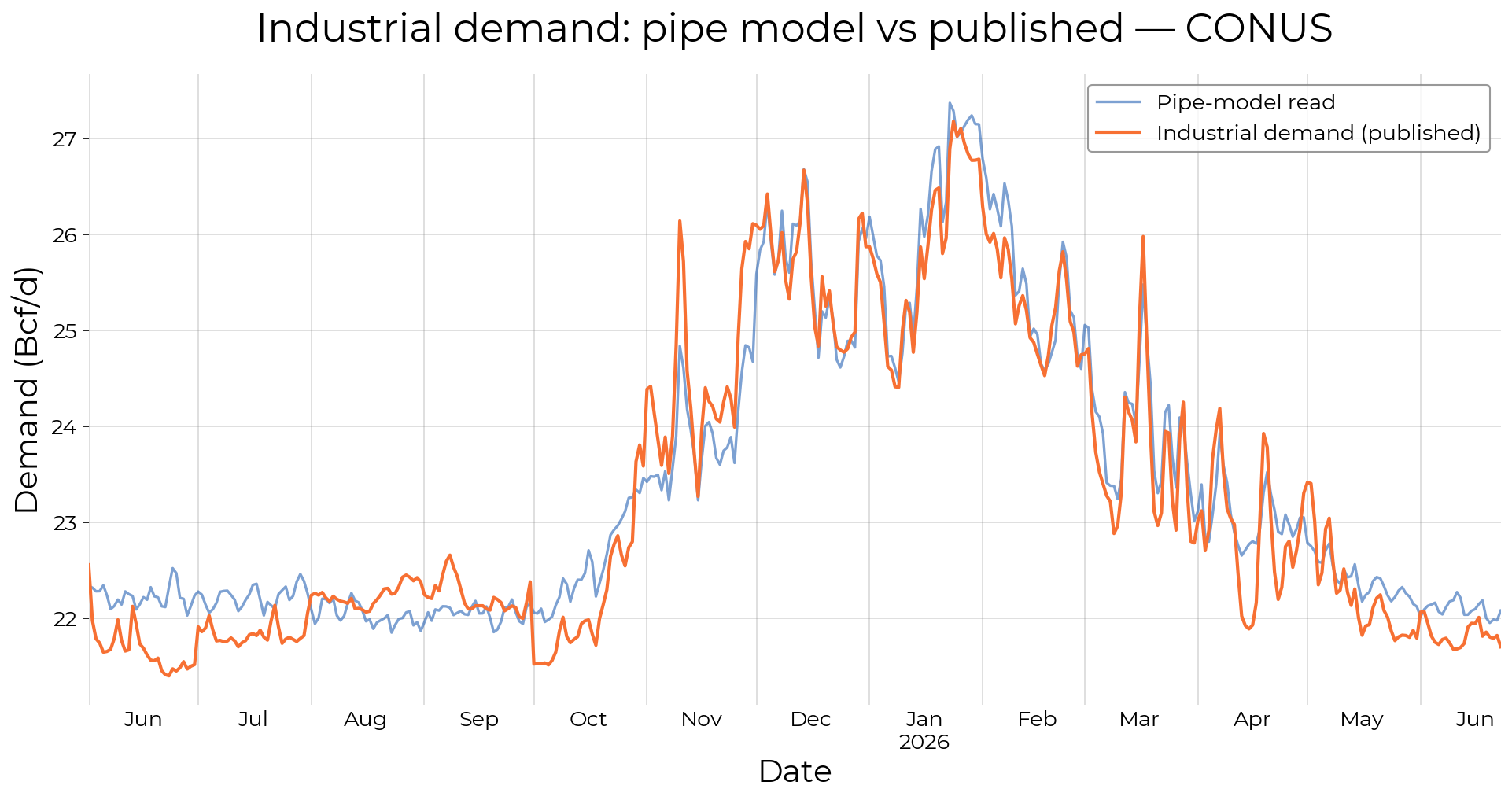
Industrial demand is only slightly responsive to weather (some parts of industrial include process heat), so it is modeled differently. Its inputs are the pipeline signal, a weather signal clipped to remove temperature swings that do not belong in demand, and a measure of economic activity (for longer-term trends). These combine in a linear model where the pipeline signal sets the level while the economic term captures slower, activity-driven trends. The clipped weather term keeps short cold or hot spells from being read as substantial changes in industrial consumption.
Holding It Together
Each daily estimate is calibrated to the corresponding EIA monthly consumption total. The components are also made coherent across the hierarchy, so regional sectors sum to their regional totals and the regions sum to the national figure without double counting. The output is a timely, regionally resolved demand series that, combined with our production data, supports supply-and-demand balance and storage analysis.
LNG Feedgas/Imports
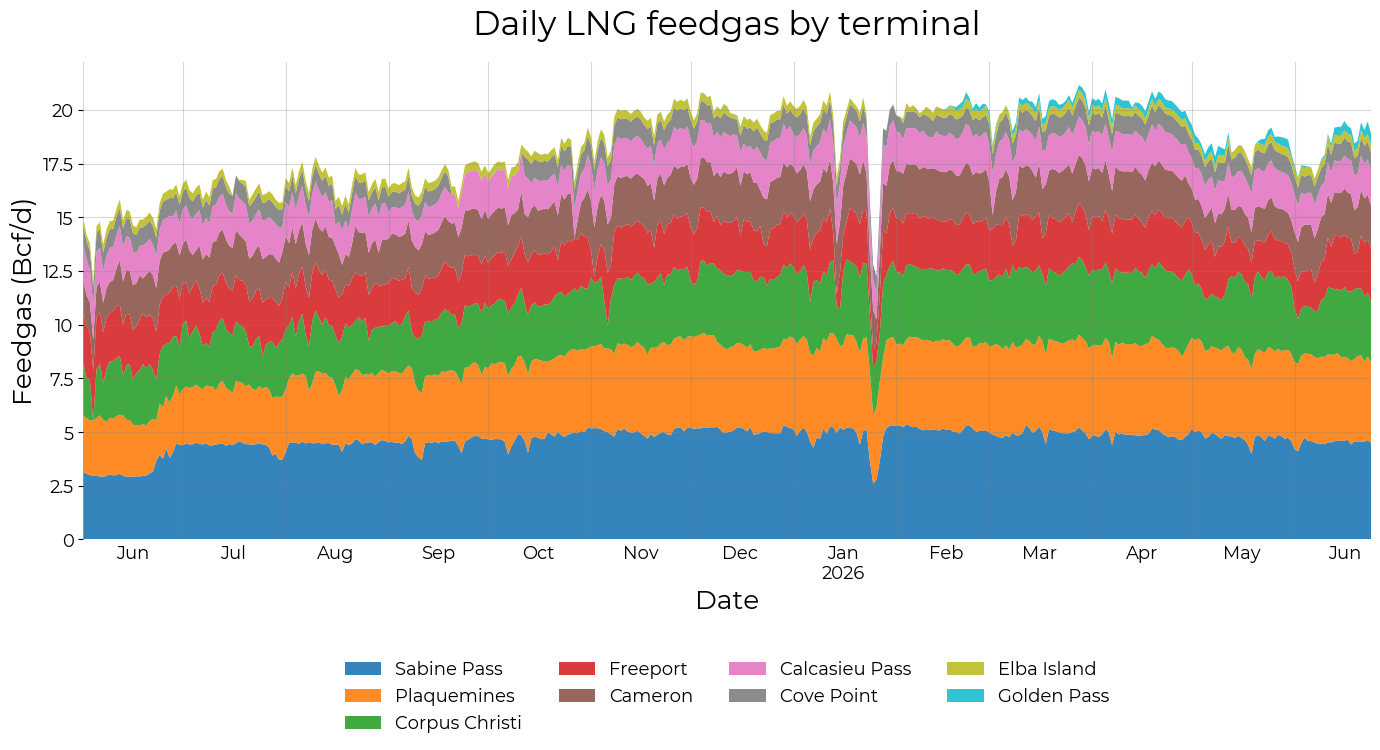
LNG feedgas is now one of the largest and fastest-growing pieces of US gas demand, and increasingly hard to measure as intrastate feeds are added. We report daily feedgas demand, in Bcf/d, at all nine major US liquefaction terminals. For most terminals this is straightforward: the gas arrives over interstate pipelines whose daily nominations we already track, so the metered nominations are the feedgas volume. Note that this is an import series for some facilities, and an import/export series for some that are bidirectional.
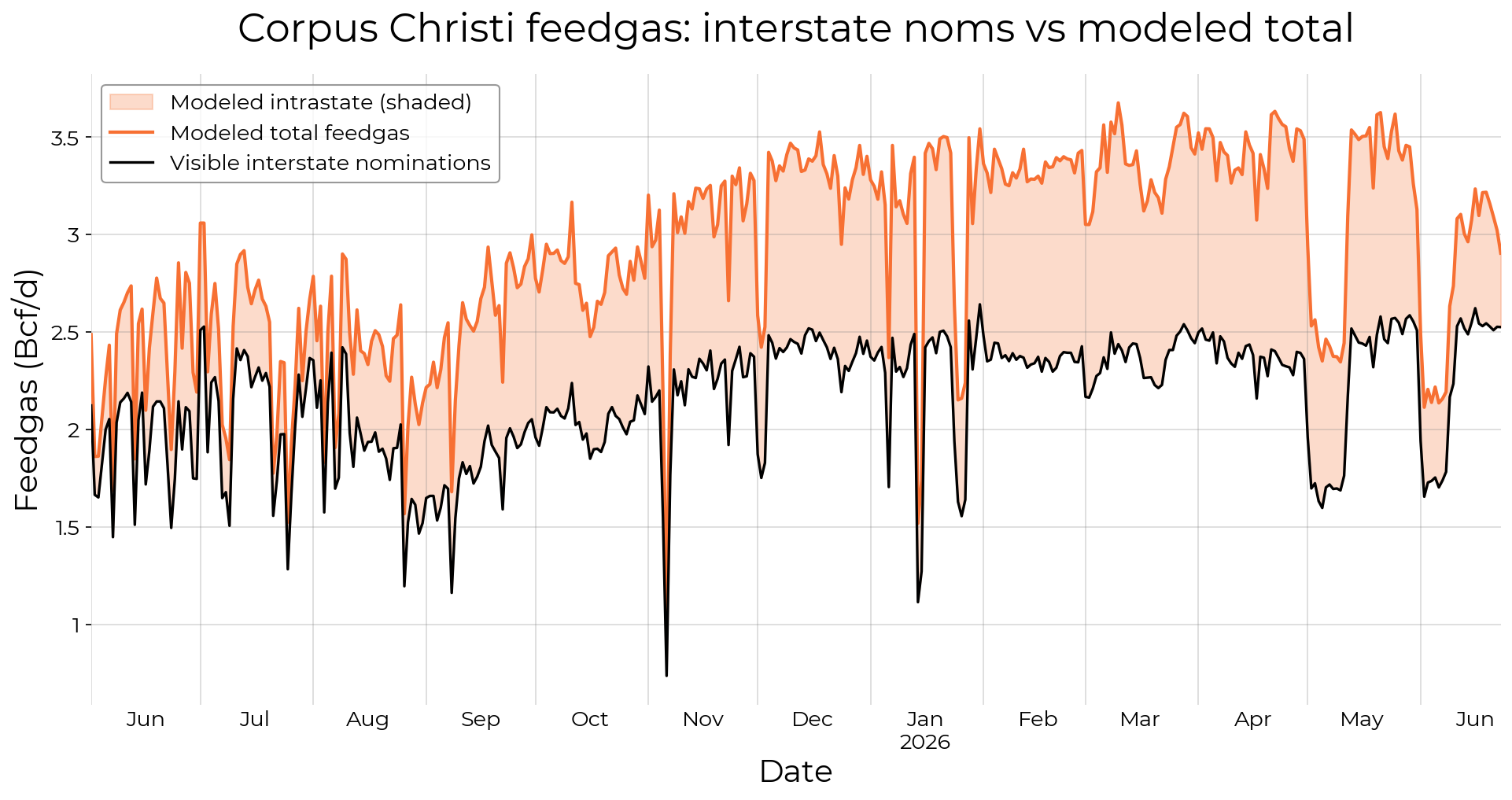
Two terminals are not so simple. Corpus Christi and Freeport draw a large share of their supply from Texas intrastate pipelines, which post no public daily nominations. Relying on visible interstate data alone would leave a persistent hole at exactly the two terminals that have driven much of the recent growth in US LNG. To recover that hidden volume, we scale each terminal's visible interstate flow up by a slowly varying factor that is calibrated against observed cargo exports from Leviaton and anchored to authoritative EIA export levels. The fast, day-to-day movement rides the live pipeline nominations; the factor carries only the slow structural drift toward intrastate supply. As a final physical check, each terminal's modeled feedgas is bounded by the rated capacity of its liquefaction trains, a cap built from each terminal's actual train inventory rather than a hand-tuned band, so it is externally verifiable and steps up on its own as new trains come online.
US-to-Mexico Pipeline Exports
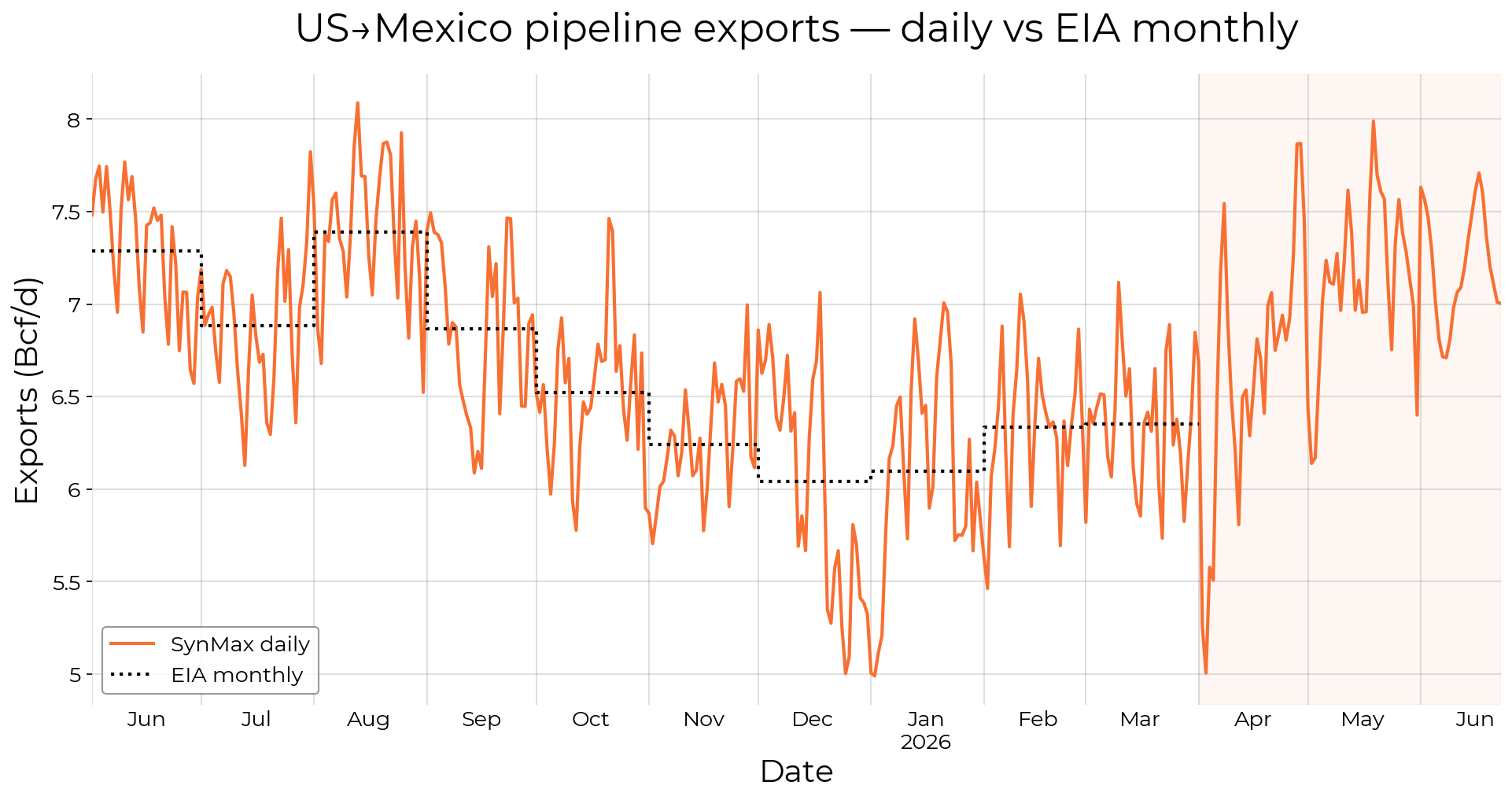
Pipeline exports to Mexico are reported as a single national daily series, in Bcf/d, that runs right up to the current gas day. We combined live US border-crossing pipeline nominations, blended with Mexican pipeline-import data and border-region weather, calibrated to EIA data, for our live data source.
The daily Mexican pipeline-import signal comes primarily from CENAGAS, the operator of Mexico's national pipeline system, which reports the gas injected into the Mexican grid. Because it is measured on the Mexican side of the border, it is an independent confirmation of how much US gas actually crossed, and it enters the model as a regressor whenever it is available. CENAGAS publishes on roughly a six-week lag, however, so for the most recent weeks the model falls back to a version driven by US border nominations and weather alone, then folds the CENAGAS signal back in once it catches up.
For the recent months EIA has not yet published, those same live signals nowcast the level forward, so the series stays current and revises toward the official figures as they are released. This gives a daily view of a flow that is both large and growing, where no official daily series otherwise exists.
Canada-US Pipeline Trade
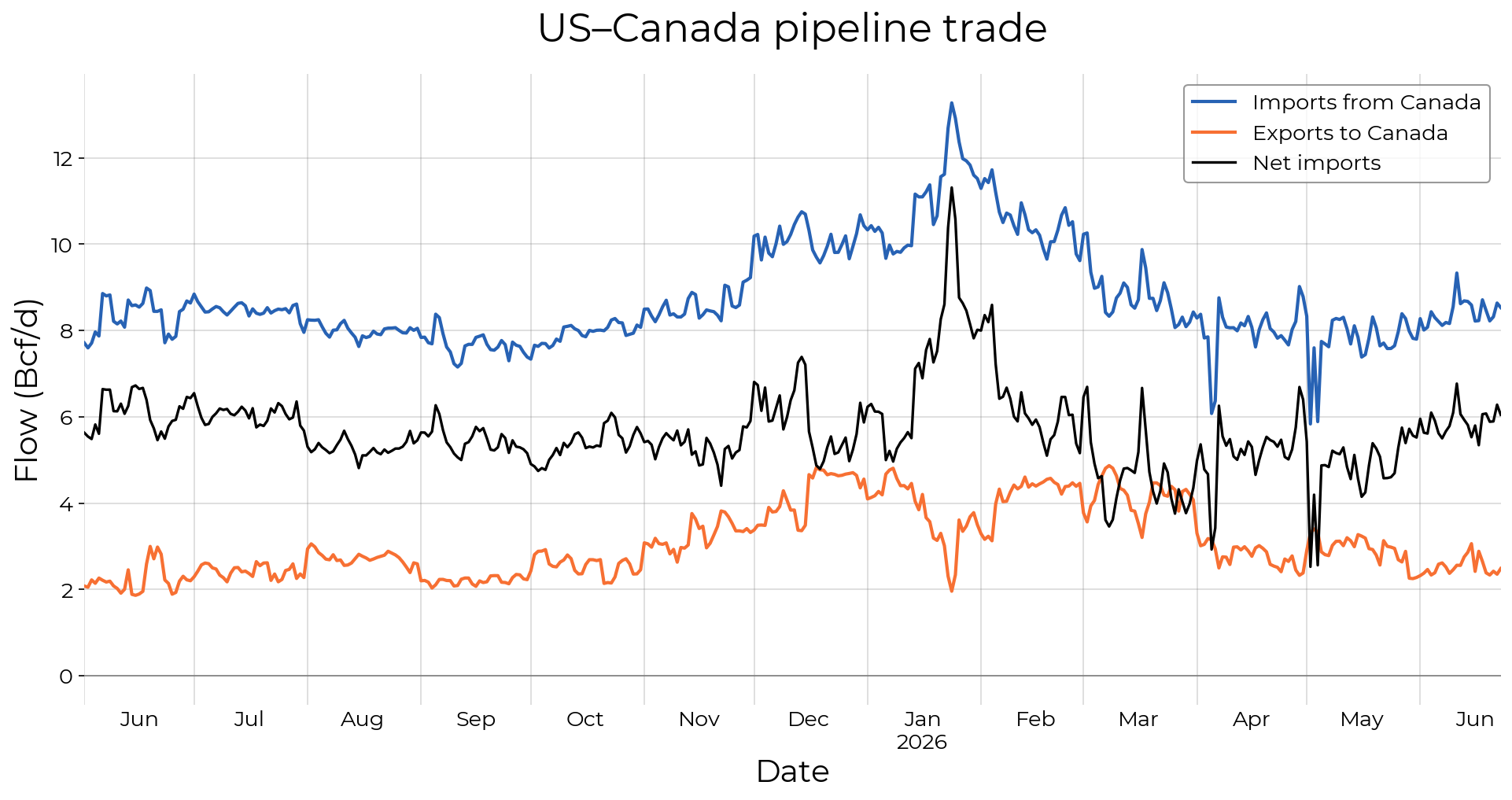
The Canadian cross-border component reports daily US-Canada pipeline gas imports, exports, and net imports, in Bcf/d. We build it directly from daily pipeline nominations at a curated set of border-crossing points, summing the metered flows in each direction, so the series refreshes as soon as new pipeline data lands. Canada is the largest single source of US gas imports as well as a meaningful export market, and these flows swing seasonally with winter heating demand on both sides of the border.
Supporting Components
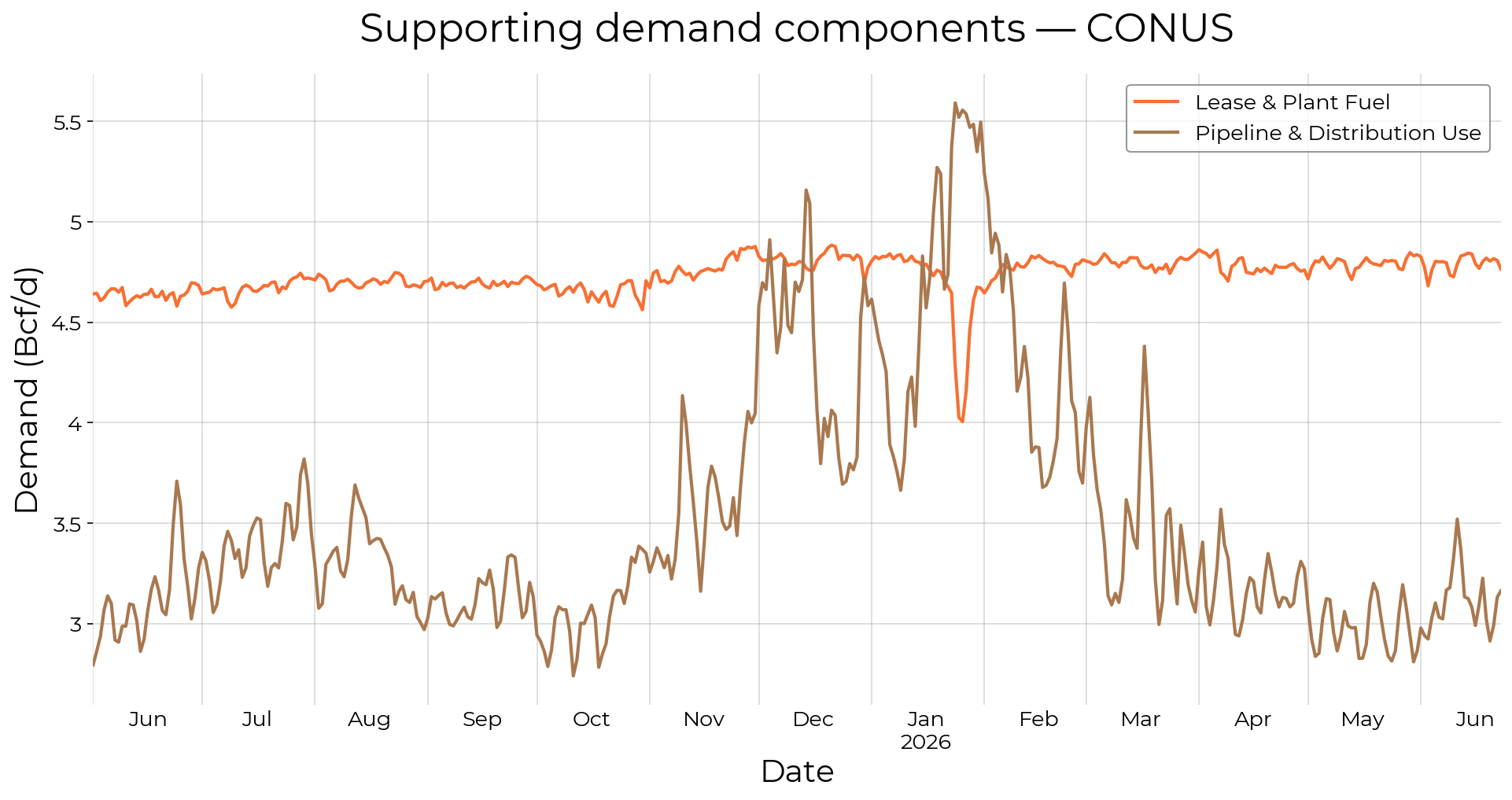
A few smaller components round out the balance. Lease and plant fuel, the gas burned in upstream production and processing, is tied to our daily natural gas production estimate, so it moves with production rather than with weather. Pipeline and distribution use, the gas consumed as compressor fuel moving gas through the system, is fit on total demand. Vehicle fuel is small and slow-moving, so we simply carry the last published EIA figure forward. As with every other component, each is reconciled to the EIA monthly record so it stays consistent with the official totals.
What's Next
Demand is being added to the SynMax frontend and the traditional API over the coming weeks, so the same daily series will be available wherever you already work with our data. As always, if you have questions about the methodology or how to access the data, reach out at support@synmax.com.