2/5/25
Introduction
Natural gas producers face the critical question of when to curtail production during periods of depressed prices. This analysis examines the shut-in economics of the two largest U.S. dry gas producing regions — the Northeast (NE PA, SW PA, WV, OH, priced at Dominion South) and the Haynesville (LA, TX, priced at Henry Hub) — over the past three years. By mapping operator-level variable costs against historical spot prices, we identify the price thresholds at which producers face economic incentives to curtail output, and estimate the volume of production at risk at each price level using a graduated curtailment model.
Production vs Spot Price
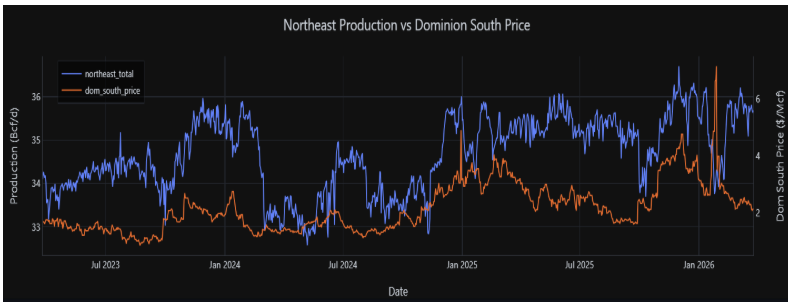
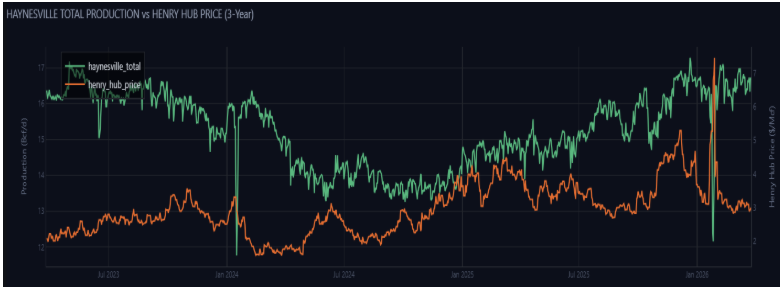
Daily dry gas production from SynMax Hyperion is plotted alongside the relevant spot price for each basin. The Northeast currently produces approximately 36 Bcf/d across four subregions, priced at the Dominion South hub. The Haynesville currently produces approximately 17 Bcf/d across Louisiana and Texas, priced at Henry Hub.
Historical Shut-In Conditions
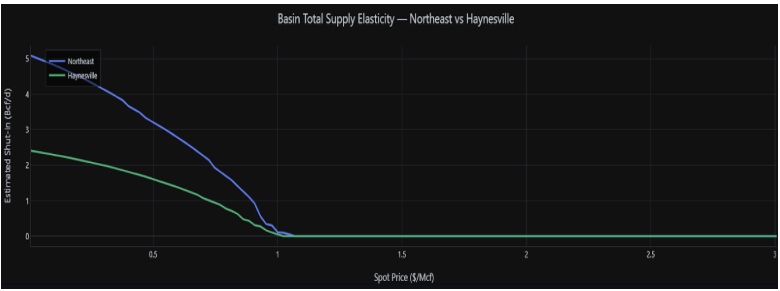
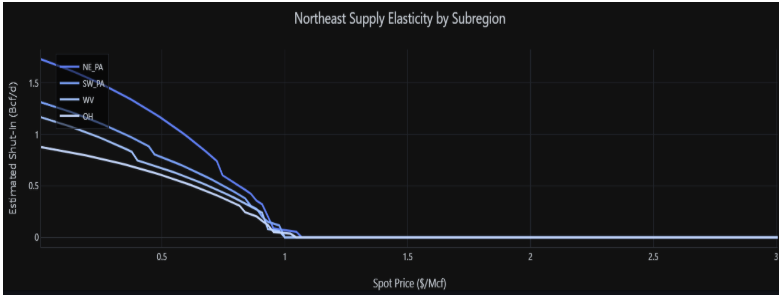
Over the past three years, the Northeast experienced 29 days where Dominion South fell below the highest operator variable cost in the region ($1.06/Mcf), with 19 of those days showing coincident production declines likely attributable to partial shut-ins. The three-year low of $0.86/Mcf (September 2023) pushed prices below most operators' variable costs, putting an estimated ~1.3 Bcf/d of Northeast production at risk of curtailment based on historical data.
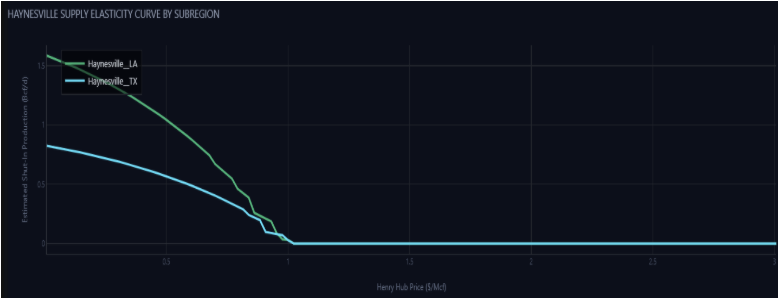
In contrast, the Haynesville experienced zero price-driven shut-in days over the same period. Henry Hub's three-year low of $1.57/Mcf remained 54% above the highest Haynesville operator variable cost ($1.02/Mcf). All observed production drops in the Haynesville were attributable to weather-related freeze-off events, not economic shut-ins. Hypothetically, Henry Hub would need to fall to $0.50/Mcf before approximately 1.6 Bcf/d of Haynesville production would face curtailment pressure.
Operator Variable Costs
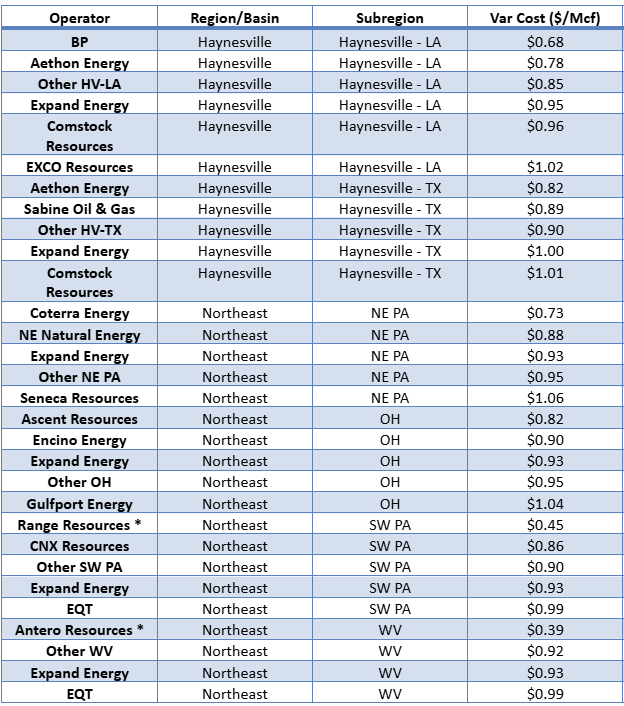
Variable costs include lease operating expenses (LOE), gathering, processing, transportation, severance tax, and G&A. NGL-rich producers (marked with *) benefit from NGL revenue credits that substantially reduce their effective gas breakeven price.
Supply Elasticity Curves
Supply elasticity curves estimate the volume of production that would be curtailed at each spot price level. The model uses a graduated partial curtailment approach: when spot price falls below an operator's variable cost, curtailment begins at 3% and rises gradually to a maximum of 20% as the price deficit widens. Northeast producers historically have begun shutting-in about 3% of total production. While there hasn’t been a time over the last 3 years to see a maximum amount of shut-ins, crude oil production during the worst of the Covid demand destruction lockdowns saw a production drop of around 20%. The formula is:
fraction = min(0.20, 0.03 + 0.17 × (1 - e^(-deficit/0.75)))
This approach reflects the reality that operators don’t shut-in 100% of production even at deeply uneconomic prices, due to contractual obligations, take-or-pay commitments, hedging positions, and well integrity considerations. Overall, there is a combination of actual historical data and theoretical assumptions when trying to estimate production shut-in pricing levels by producer.
Expand Energy Spotlight
Expand Energy is the largest U.S. natural gas producer with approximately 8.4 Bcf/d of combined production spanning both the Northeast and Haynesville basins. With variable costs of $0.93–$1.00/Mcf across its operating areas, Expand sits in the middle of the industry cost curve. Under the 3% to 20% graduated curtailment model, approximately 0.5 Bcf/d of Expand's Northeast production would face curtailment pressure at the three-year Dominion South low of $0.86/Mcf. NGL-rich producers like Antero Resources ($0.39/Mcf net variable cost) and Range Resources ($0.45/Mcf) have significantly lower shut-in thresholds due to NGL and crude oil condensate revenue credits — Dominion South would need to fall below $0.39/Mcf before Antero faces economic shut-in pressure.
Methodology
Production data is sourced from SynMax Hyperion daily modeled dry gas production (six subregions, three years). Spot prices are from Bloomberg. Operator variable costs are compiled from public 10-K/10-Q filings (Q4 2025) and include LOE, gathering, processing, transportation, severance tax, and G&A. NGL pricing uses Mont Belvieu benchmarks minus $0.10/gallon for Northeast netback. Crude oil condensate is priced at 85% of WTI. Historical shut-in identification flags days where spot price fell below the highest operator variable cost in a subregion with coincident production declines exceeding 0.1 Bcf/d versus a 30-day rolling baseline.
See the dashboard created with Synmax Agents.
As usual, contact support@synmax.com with questions.