Kinder Morgan (KMI) Kinder Morgan estimates Lower 48 LNG export demand growth to be around 16 Bcf/d...
The $3.00 Question
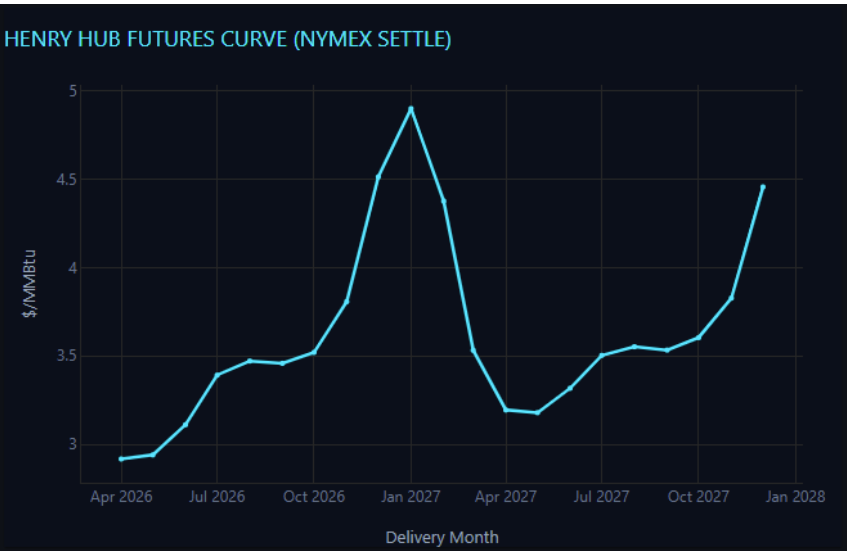
The Haynesville shale sits at a crossroads. Henry Hub natural gas is hovering just under $3.00/MMBtu for the April 2026 and May 2026 futures contracts, a price that leaves most of the basin economically viable on a D&C basis but that still punishes inefficiency. The forward curve offers relief through the summer cooling season, with prices climbing to around $3.40 by July, but operators planning 2026 capital programs need to know where the economic floor actually sits today -- not where the market hopes it will be six months from now.
This analysis examines D&C break-even economics for every major Haynesville operator using a pad-level PV10 methodology applied to 1,169 wells completed between 2023 and 2025. The results reveal a basin that has materially improved its cost structure over the past three years -- and an emerging divide between operators that are thriving and those at risk of cutting back on CapEx and or getting acquired.
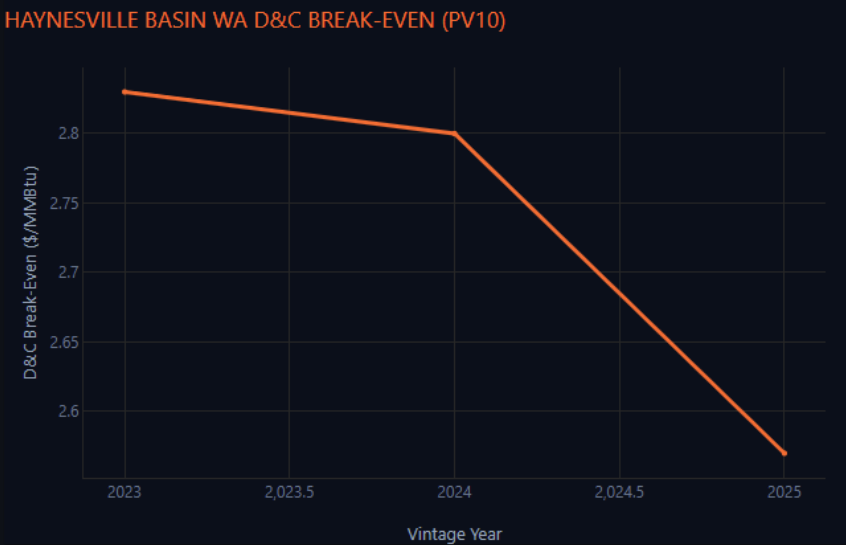
Basin-Wide Break-Evens Are Falling
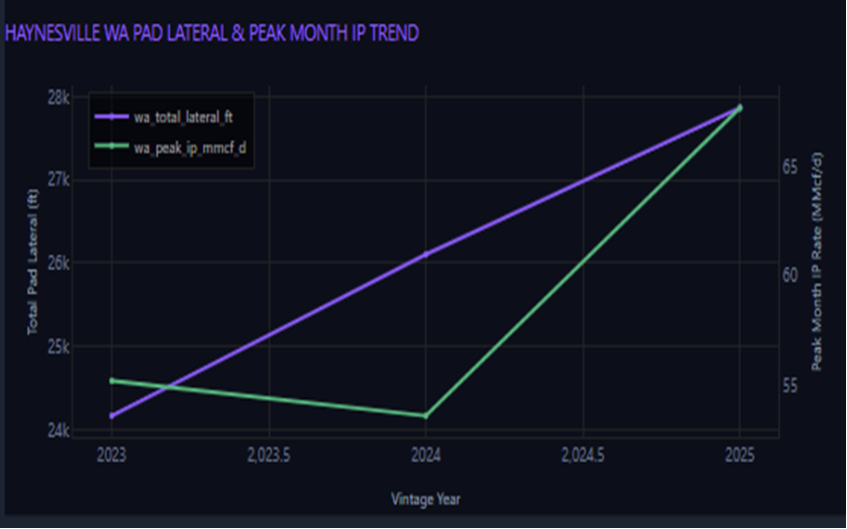
The weighted-average D&C break-even for the Haynesville basin dropped from $2.83/MMBtu in 2023 to $2.57 in 2025 -- a 9% improvement in two years. Three structural forces are driving this compression. First, drilling and completion costs have fallen from $1,277 per lateral foot to $1,078, a 16% reduction that reflects both service cost deflation and improved operational efficiency. Second, average pad lateral footage has expanded from 24,168 feet to 27,867 feet as operators push toward longer laterals and denser spacing. Third, and most importantly, peak-month IP rates have surged from 55.2 MMcf/d to 67.7 MMcf/d per pad -- a 23% increase that indicates genuine well quality improvement, not just longer laterals.
When normalized for lateral length, IP efficiency improved from 2.28 MMcf/d per thousand feet in 2023 to 2.43 in 2025. This is the critical metric: it shows that the productivity gains are not simply a function of drilling longer wells, but reflect genuine improvements in completion design, fluid systems, and target selection.
The Operator Divide: $2.28 to $3.65
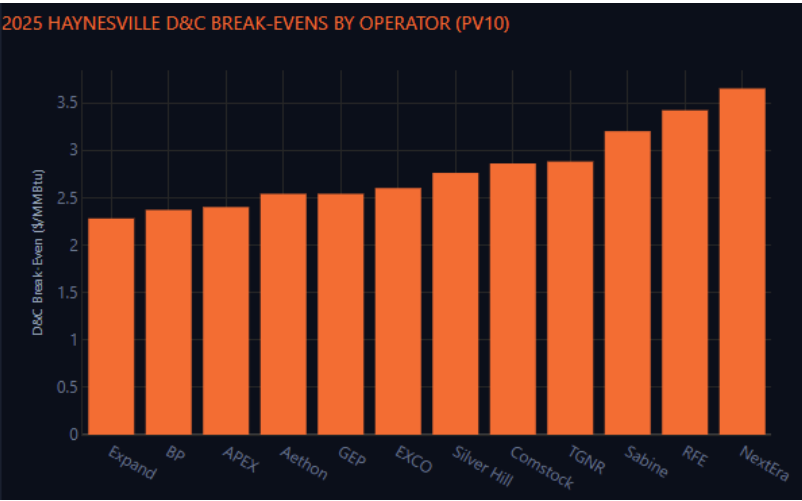
At the top of the leaderboard, Expand Energy leads the basin with a D&C break-even of just $2.28/MMBtu across 46 pads and 110 wells -- the largest sample size of any operator. Their advantage comes from an exceptional combination of the lowest D&C cost per foot ($1,012) and the second-highest IP efficiency (2.99 MMcf/d/kft). BP follows at $2.37 with the highest absolute IP rates in the basin (119 MMcf/d per pad) driven by massive pad designs averaging nearly 34,000 feet of total lateral. APEX, despite a smaller 2025 sample of 2 mature pads, clocks in at $2.40 and has shown steady year-over-year improvement from $2.95 in 2023.
The middle tier -- Aethon ($2.54), GEP ($2.54), EXCO ($2.60), and Silver Hill ($2.76) -- all sit below the current Henry Hub front month futures contract. But the bottom of the ranking tells a different story. Sabine at $3.20, RFE at $3.42, and NextEra at $3.65 are all currently uneconomic against spot and front month futures contract pricing. These operators are surviving on forward hedges and the expectation of summer price recovery, but a sustained sub-$3.00 environment would force difficult capital allocation decisions.
Two-Year Trajectory: Who Is Improving?
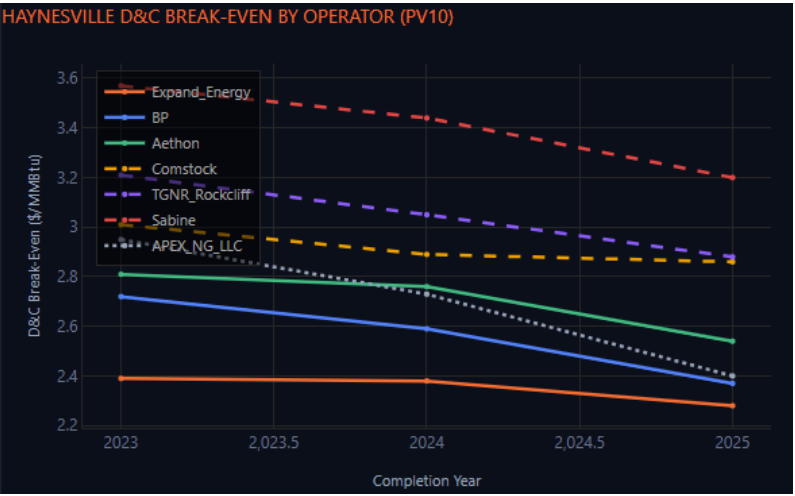
The three-year trend lines reveal which operators are structurally improving and which are treading water. The most dramatic improvement belongs to Silver Hill, whose break-even dropped from $3.26 to $2.76, a $0.50 reduction driven primarily by completion quality gains. APEX showed steady progress ($2.95 to $2.40), as did Sabine ($3.57 to $3.20).
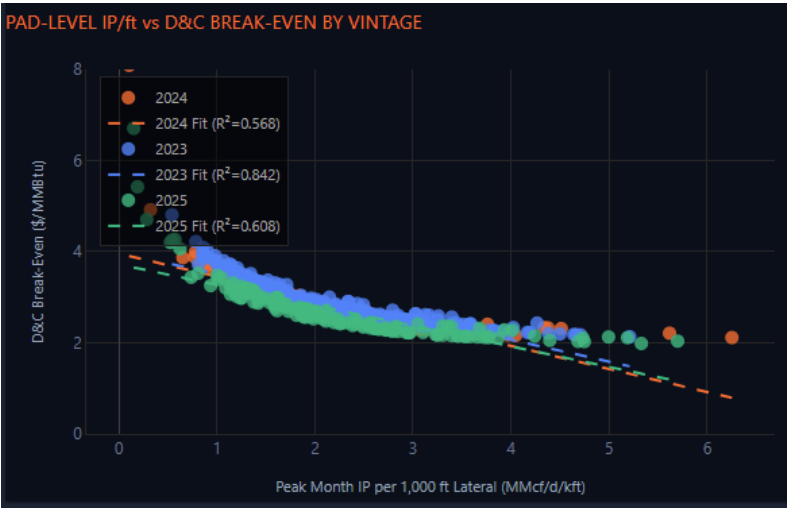
The scatter plot of IP efficiency versus break-even reveals a tight inverse relationship: operators producing more gas per foot of lateral consistently achieve lower break-evens. This is intuitive but the magnitude is striking -- moving from 1.0 to 3.0 MMcf/d/kft cuts the D&C break-even roughly in half. The implication is clear: in Haynesville, well quality dominates cost structure. An operator can have above-average drilling costs and still achieve below-average break-evens if their wells outperform.
What to Watch Going Forward
1. The Rig Response at $3.00. Haynesville rig counts have been range-bound for the past year as operators waited for a sustained signal above $3.00. With the forward curve now clearing that threshold through summer, watch for a step-up in drilling permits and rig mobilizations from Expand Energy, Aethon, and BP -- the three operators with the deepest sub-$3.00 break-evens and the balance sheet capacity to accelerate. A 10-15% increase in basin rig counts by Q3 2026 would signal that operators believe the price recovery is durable, not seasonal.
2. The Lateral Length Ceiling. Average pad lateral footage has grown 15% in two years, from 24,168 to 27,867 feet. But the marginal returns on longer laterals are diminishing -- some operators are already reporting toe-stage underperformance on laterals beyond 15,000 feet per well. If the basin hits a lateral length plateau, further break-even improvement will have to come entirely from cost reductions and completion optimization, a harder path than simply drilling longer.
3. LNG Export Demand Pull. Haynesville's proximity to Gulf Coast LNG terminals remains its structural advantage over every other gas basin in the country. With Golden Pass Train 1 expected online in March 2026, an additional 0.7 Bcf/d of export demand is coming to market soon. This demand pull will benefit Haynesville producers.
4. Service Cost Trajectory. The 16% drop in D&C cost per foot ($1,277 to $1,078) has been a tailwind, but it may be nearing a floor. Pressure pumping companies have consolidated aggressively, and frac sand prices have stabilized after two years of deflation. If service costs flatten or tick higher in a rising-activity environment, break-evens could stall even if well quality continues to improve. Watch the spread between the lowest-cost operators (Expand at $1,012/ft) and the highest (BP at $1,232/ft) -- convergence would signal a tighter services market.
5. Consolidation Pressure on the Tail. The $1.37 gap between the best and worst operator break-evens creates a natural consolidation dynamic. Operators like RFE ($3.42) and NextEra ($3.65) hold acreage that would be significantly more economic in the hands of Expand Energy or BP. If gas prices remain in the $2.75-3.25 range -- economic for the leaders, marginal for the laggards -- expect M&A transactions to accelerate in Haynesville. The Haynesville is increasingly a scale game, and operators that cannot drive IP efficiency above 2.0 MMcf/d/kft will face mounting pressure to sell.
See the dashboard created with Synmax Agents.
As usual, contact support@synmax.com with questions.
Methodology
Scope: 1,169 horizontal Haynesville wells completed 2023-2025 across 513 wellpads and 12 operators. Wells filtered by horizontal_length > 3,000 ft and minimum 3 months of production history.
IP Rate: Peak month production -- the highest average daily gas rate observed within the first 6 producing months.
Pad-Level Analysis: Production and lateral footage aggregated at the wellpad level to eliminate state-level pad-allocation reporting bias (affects 67% of NextEra and 31% of APEX wells).
EUR Model: Sub-linear power fit: EUR/kft = 1.408 x (IP/ft)^0.452. Calibrated on 360+ mature wells with 24+ months of production. High-IP wells decline faster (16% retention at month 24 vs 29% for low-IP wells).
PV10: 10% annual discount rate applied to projected cash flows. PV10 factor varies by IP (0.50-0.62) reflecting front-loaded production profiles for high-IP wells.
Costs: D&C costs estimated at $1,012-1,232/ft by operator (2025). LOE $0.28/Mcf, gathering & processing $0.60/Mcf. Severance tax: LA 3.25%, TX 7.5%. Royalty burden: LA 25%, TX 22.5% NRI.
Data Sources: Well attributes and monthly production from Hyperion (hdl.wells, hdl.production_by_well). Henry Hub futures from Bloomberg B-PIPE. D&C cost estimates from public filings and regional benchmarks.
Sources: Hyperion Supply (SynMax), Bloomberg B-PIPE, EIA, State Regulatory Agencies
Hyperion Research | March 2026 | SynMax Agents Platform