Historical Review & Probabilistic Build Profiling
April 2026 | 138 Projects | 9 GW | 82% of US 2025 Capacity
|
What you will know after reading this report Data center build timelines have accelerated by five months - for projects that break ground - and most planning models haven't caught up. This report gives you a probability-based framework, built from 138 real projects and weekly satellite monitoring, to replace assumption-based forecasts with data-backed earliest, median, and latest online dates. |
The Planning Problem
Without accurate build timelines, capacity commitments get made too late, procurement cycles slip, and competitive windows close. For years, planners penalized large-footprint projects with extended timelines — an assumption baked into models, financial forecasts, and supply agreements.
That assumption is now wrong. The 2025 dataset shows a structural shift: hyperscale builds are completing at the same pace — or faster — than smaller facilities. If your models still carry legacy delay penalties for large footprints, they are off by roughly five months - the measurable gap between legacy baseline assumptions and 2025 actuals.
The Surprise That Defined 2025
In the spring of 2025, Meta began installing $100M+ GPU clusters inside what the industry quietly calls “tents” — industrial-grade, climate-controlled fabric structures erected before the permanent concrete walls were cured. It was unconventional. It was also a preview of what construction efficiency looks like when scale is no longer the enemy of speed.
|
LAND CLEARING Apr 27, 2025 |
FIRST STRUCTURES Jun 22, 2025 |
TENTS DEPLOYED GPU clusters online |
LATEST REVIEWED Apr 7, 2026 |
Meta's Temporary Fabric Structure (TFS) approach — deploying pre-fabricated power and cooling modules inside climate-controlled enclosures while permanent structures were still curing — set the record for fastest single-project online date in our 2025 dataset.
4/27/2025 - Land Clearing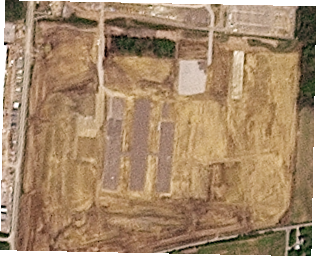
6/22/2025 - First Structures
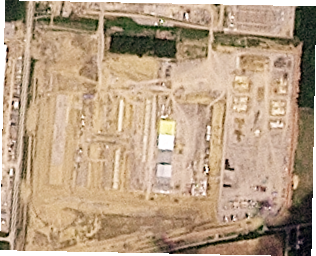
4/7/2026 - Latest Reviewed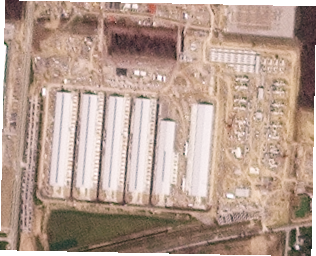
|
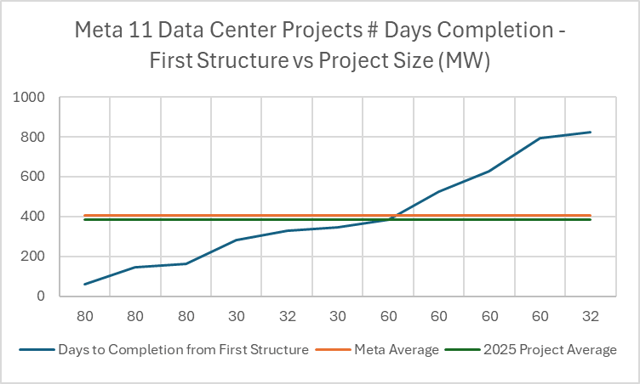
Important distinction: single project vs. fleet performance While Meta achieved the fastest individual project in the dataset, this speed was not uniform across their 11-project portfolio. Their fleet-wide average build time was above the industry average — confirming that construction methodology, not company identity, is the primary variable. Meta's TFS projects are treated as outliers in our median build calculations due to their specialized use case and higher operational risk profile.
|
Dataset & Methodology
This review examined 138 data center projects scheduled to come online in 2025, monitored through the Vulcan Platform's weekly visual progress tracking. Benchmarks were established by measuring the duration between three milestone events — land clearing, first structure, and construction completion — and comparing against Vulcan's historical data layers.
|
138 Projects Analyzed |
9 GW Capacity Represented |
82% of Total US 2025 Additions (~11 GW) |
Key Findings: The Scale Efficiency Shift
1. Size Is No Longer Destiny
The primary finding of this review is a decoupling of project size from construction duration. Large-scale hyperscale campuses — which accounted for 94% of the 2025 sample — frequently achieve similar or faster completion rates than smaller facilities. This is the core of what we call the "Go Big or Go Home" efficiency thesis.
Three forces are driving this parity:
- Standardized modular designs that eliminate site-specific engineering rework
- Vertical supply chain integration that reduces procurement lead times
- Temporary bridge infrastructure (TFS) that decouples GPU deployment from structural completion
2. Sector & Geographic Variables
"Mining" facilities (cryptocurrency / high-density compute) demonstrate the fastest transition from land clearing to first structure, though their presence in the 2025 pipeline was minimal relative to the hyperscale wave.
Geographic location has largely ceased to be a primary determinant of build speed. Developers increasingly apply standardized global design templates that absorb local regulatory and environmental variables, resulting in consistent timelines across regions.
Probabilistic Build Profiling
The central objective of this research is to replace static estimates with a probability distribution for each project. By analyzing the duration from first structure to online date across the full dataset, we have established a new predictive model with three reference points: earliest, median, and latest online.
|
Metric |
2025 Observation |
Planning Implication |
|
Earliest Online |
Improved by 5 months |
Enables aggressive early-mover capacity planning for projects using bridge infrastructure. |
|
Median Online |
Improved by 5 months |
The new baseline for standard forecast models. Any model using pre-2025 medians is structurally late. |
|
Outlier Management |
High variance flagged |
Hyper-accelerated bridge projects and extreme delays are excluded from median calculations but documented for range analysis. |
What This Means for Your Planning
The 2025 data settles a question that has shaped infrastructure planning assumptions for a decade: scale is no longer a timeline liability. A hyperscale campus build no longer carries longer completion risk than a midsize facility — and in many cases, it completes faster, driven by modular power skids, low-carbon pre-cast concrete, and temporary bridge infrastructure.
Three implications for capacity planners:
- Retire the size penalty. Models that apply timeline extensions for large-footprint projects will systematically mis-sequence capacity commitments.
- Update your baseline by five months. The median build cycle is five months shorter than legacy models reflect — this affects procurement timing, power agreements, and go-to-market sequencing.
- Use probability ranges, not point estimates. The variance in the 2025 dataset is real. Earliest and latest online dates matter as much as the median for robust planning.
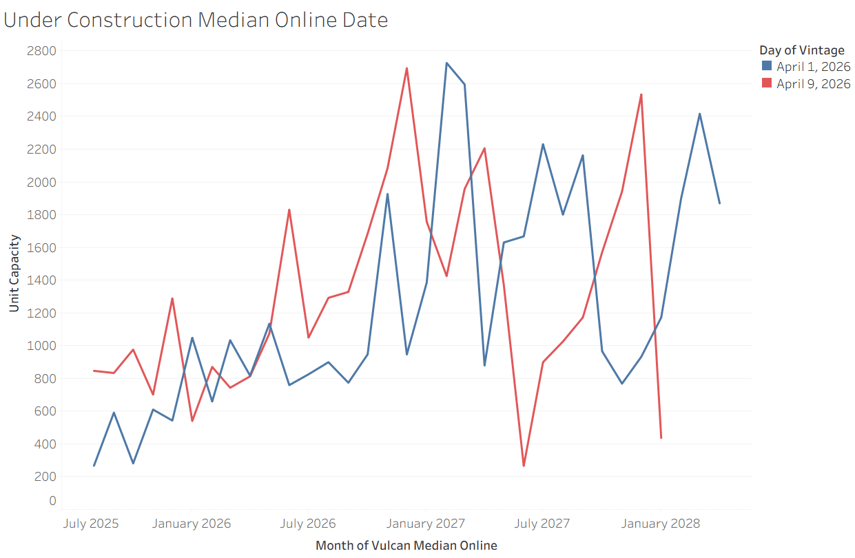
The report is focused on construction once construction begins. Construction speed only matters for projects that actually start. A second variable compounds the planning challenge. When 2026 pipeline announcements first emerged, nearly 600 projects over 30 GW claimed they were coming online in 2026. Currently the likely 2026 numbers are around 200 projects totaling around 10 GW.
|
Access Your Project-Specific Build Profile Vulcan Platform clients can now generate probability distributions — from earliest to median to latest online date — for any data center or power project in the dataset. Contact your Vulcan representative (David Bellman dbellman@synmax.com) or log in to the platform to run a project-specific or operator-specific analysis. |