China's Divergence from US LNG
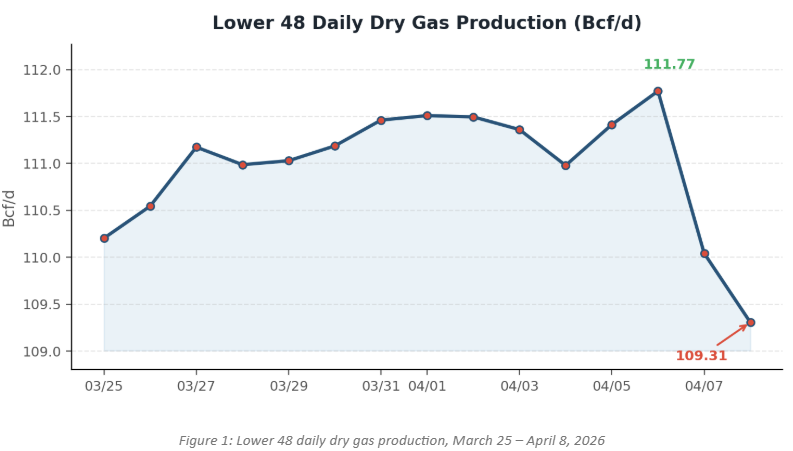
Lower 48 natural gas production fell sharply over the past two days, dropping 2.46 Bcf/d from 111.77 Bcf/d on April 6 to 109.31 Bcf/d on April 8—settling 1.92 Bcf/d below its prior seven-day average of 111.23 Bcf/d. A potential 0.30 Bcf/d (See the Dashboard note on “MISSING / LATE DATA”) of the April 8 production decline will likely get revised upward due to the usual lack of nominations and missing data on same day production data. The decline marks the steepest two-day drop since the late-March maintenance cycle and touches the lowest daily print since mid-March. We are in the Q2 pipeline maintenance season and a production decline into April compared to March was expected per the long-term production forecast (110.51 Bcf/d in the April long-term production forecast compared to 110.79 Bcf/d for the March long-term production forecast).
Subregional Breakdown
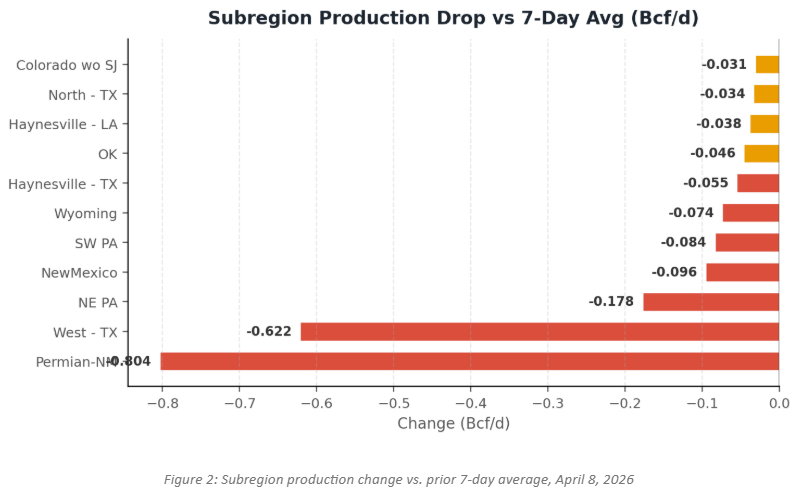
The Permian Basin absorbed the brunt of the decline. Permian-NM receipts fell 0.80 Bcf/d below their seven-day average, while West-TX dropped 0.62 Bcf/d. Together the two Permian sub-regions account for roughly 60 percent of the Lower 48 decline. In the Northeast, NE PA slipped 0.18 Bcf/d and SW PA shed 0.08 Bcf/d, largely tied to compressor-station maintenance on the Equitrans system and scheduled work on the Rover pipeline in West Virginia. Wyoming and New Mexico posted smaller declines of 0.07 and 0.10 Bcf/d, respectively.
Cause Analysis
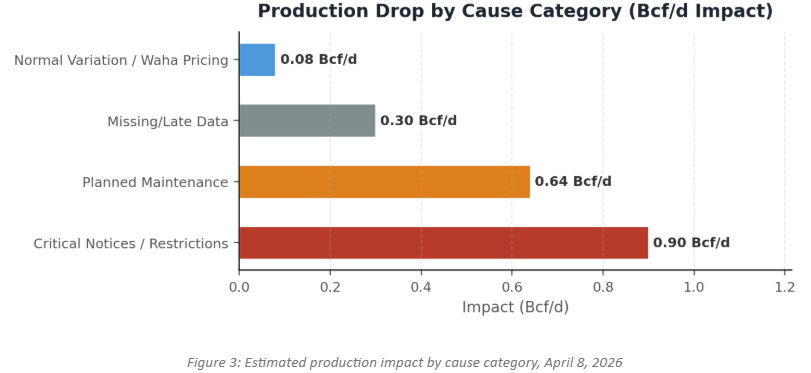
Critical notices and force-majeure events were the single largest driver, accounting for an estimated 0.90 Bcf/d of the decline. Transwestern posted an Overage Alert for its Phoenix delivery area (Notice 116273), constraining receipts out of the Permian-NM corridor. Gulf Run declared force majeure on its mainline (Notice 61032), curtailing Haynesville-TX receipts, and Enable/ONEOK's Red Oak–Latimer point in Oklahoma fell to zero. However, due to excess available spare pipeline capacity in Haynesville, production in the basin is likely to get re-routed from any maintenance or force majeure event.
Planned maintenance contributed another 0.64 Bcf/d. Equitrans compressor work in SW PA alone removed roughly 0.37 Bcf/d, while Rover's 2026 turnaround in WV cut 0.14 Bcf/d. El Paso Natural Gas's April maintenance in New Mexico and Gulf Run's Westdale Zone 1 work (Notice 61691, through April 17) accounted for the remainder.
Missing or late-reporting data explains approximately 0.30 Bcf/d. Thirty-two receipt points reported zero on April 8 after carrying positive volumes the prior day—notably REX Seneca Noble in Ohio (0.157 Bcf/d), ANR Fort Elliott in Texas (0.078 Bcf/d), and NGPL Wheeler (0.072 Bcf/d). These gaps are likely data-latency artifacts and may get revised upward. The residual 0.08 Bcf/d falls within normal day-to-day variation, compounded by persistently negative Waha pricing now running a record 42 consecutive days near –$6/MMBtu.
Near-Term Outlook
Several maintenance windows remain open: ONEOK WesTex has a 17-day turnaround running through April 24 in the Permian, Enable Gas's Amber compressor station faces 70–80 percent receipt reductions from April 13–18 in Oklahoma, and Gulf Run's Westdale work continues through April 17 in the Haynesville. Until these events clear and late-reporting points are reconciled, Lower 48 production is likely to remain under pressure in the 109.5 to 110.5 Bcf/d range.
See the dashboard created with Synmax Agents.
As usual, contact support@synmax.com with questions.